

A chart has been making the rounds this week comparing phone vendors by market share in 2010 and 2025, and the detail worth staring at is not the brand names -- it is the flags. The 2010 top eight spanned six countries on four continents: Finland's Nokia at 28.9%, Korea's Samsung and LG, Canada's BlackBerry, America's Apple and Motorola, the Swedish-Japanese Sony Ericsson, and one Chinese vendor, ZTE, in eighth. In 2025, six of the world's eight largest smartphone vendor groups are Chinese. The two survivors, Apple and Samsung, are the only non-Chinese names left on the list.
I checked the numbers before writing this -- the figures are real, though the two columns measure different markets, which I'll flag where it matters. But the more interesting question is the one the chart can't answer: how did that happen? The standard one-word answer, "cheap," is mostly wrong, and the real answer should interest anyone who buys or builds physical products. It is a story about how manufacturing capability accumulates -- about Western purchase orders that built an industrial base, a Taiwanese chip company that made phone-building modular, and six brands that rode the resulting ecosystem in six different ways. My generation of operators grew up treating China as the place you sent drawings. This is the story of how the drawings learned to draw themselves.
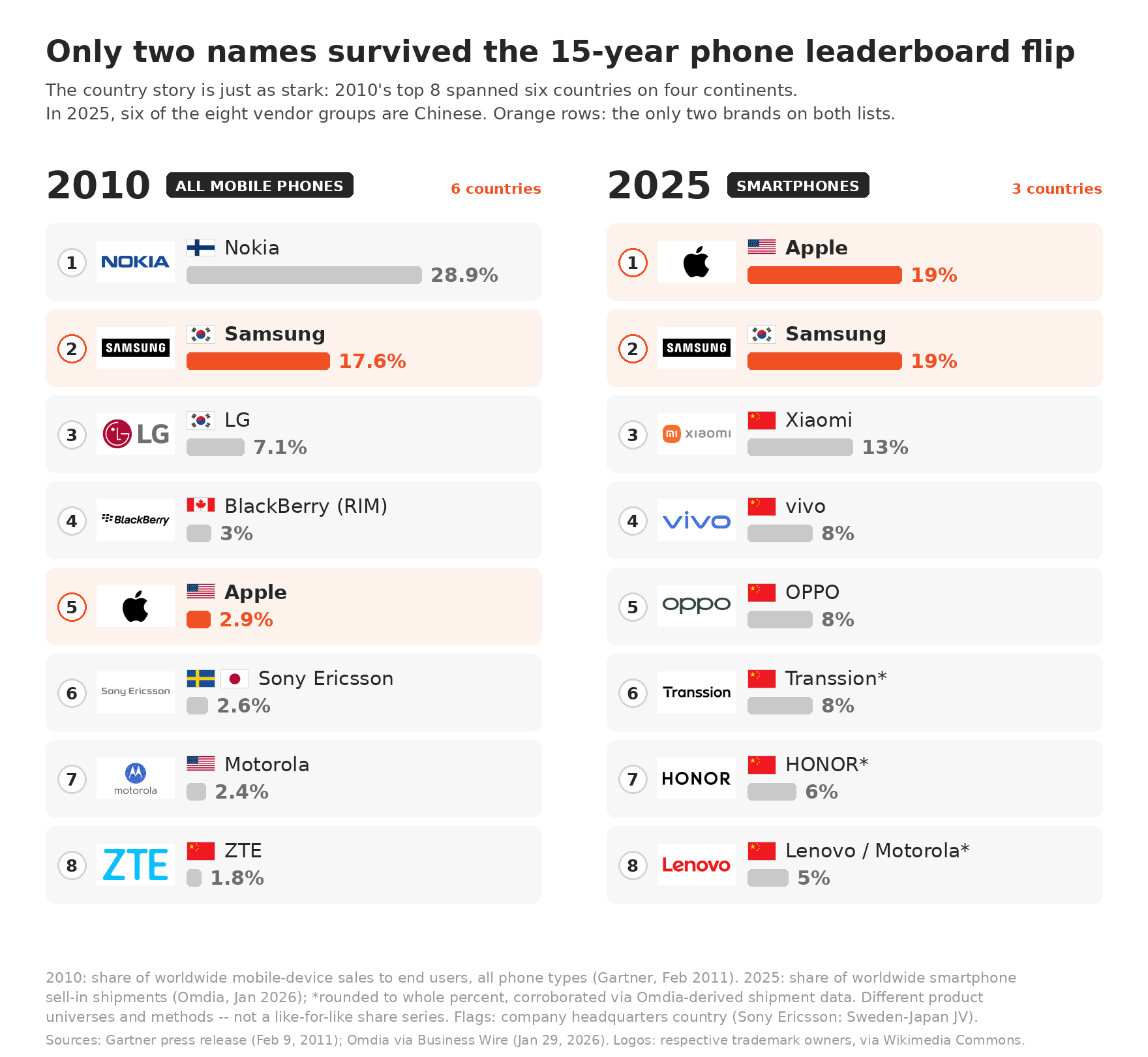
Top 8 phone vendors, 2010 vs 2025, with headquarters countries. Six countries in 2010; three in 2025 -- Sources: Gartner (Feb 2011), Omdia (Jan 2026)
Break the Groups Into Brands and Chinese Companies Still Dominate
The two columns measure different markets, which matters for reading them. The 2010 numbers count every mobile phone sold, and smartphones were less than a fifth of that market at the time; measured smartphone-to-smartphone, Apple went from about 15.7% then to 19.3% now, a steady climb rather than a fifty-fold explosion. The Chinese side needs no such adjustment, and it actually gets stronger the closer you look. Transsion is a group selling phones as Tecno, Infinix, and itel; Lenovo's phone business includes Motorola, bought from Google in 2014 for $2.91 billion; Xiaomi ships as Redmi and POCO too, OPPO includes OnePlus, vivo includes iQOO. Split every group into its constituent brands and re-rank the market, and the list below Apple and Samsung is still almost entirely Chinese -- the dominance is not an artifact of how analysts bundle conglomerates. Six of the eight largest vendor groups on earth, headquartered in three cities.
The 2010 column also hides how fast the collapse came for the leaders. Nokia was running what AMR Research had ranked the world's number one supply chain three years earlier, building more than a million devices a day across nine plants. It sold its handset business to Microsoft within four years of that chart. Operational excellence, it turns out, protects you from disruptions, not from platform shifts -- a lesson I unpacked in yesterday's post on the industrial supercycle. Today's question is different: while the old leaders were falling, what exactly was being built underneath them?
Apple's Purchase Orders Built Capabilities That Stayed in China
Start with the biggest buyer. Foxconn began major manufacturing for Apple around 2000; the first iPhone was assembled in its Shenzhen factories in 2007. Patrick McGee's book Apple in China -- built on more than 200 interviews -- documents what happened next: Foxconn's revenue grew from $1.8 billion in 1999 to $98 billion in 2010, with Apple the most consequential customer behind that curve.
The speed of the buildout is hard to overstate. In Zhengzhou, assembly lines were running by August 2010, months after Foxconn's agreement with the local government. By 2016, the New York Times' investigation of "iPhone City" found capacity for 500,000 iPhones a day, a peak workforce around 350,000, and roughly half of the world's iPhones coming out of a campus that local government had supported with more than $1.5 billion in factory construction, housing, and infrastructure. That last number matters: the ecosystem was jointly built by commercial demand and public investment, not bought off the shelf. There is precedent for the pattern -- Japan's postwar manufacturing recovery was financed substantially by American procurement during the Korean War -- but nothing at this scale or speed.
What Apple bought was never just assembly labor. Its operations chief Jeff Williams said in 2014 that more than 1,400 Apple employees were stationed in China managing manufacturing -- engineers living inside supplier factories for months, teaching processes, troubleshooting ramps. Apple's own FY2013 filing shows $6.5 billion of capital spending in the category that includes product tooling and manufacturing-process equipment, much of it machinery installed in other companies' factories. McGee reports Apple's internal accounting put its annual spending in China at $55 billion by 2015, and Reuters reported in 2021 that Apple had committed to a five-year, $275 billion investment agreement with Chinese authorities in 2016 -- a reported figure covering wages, training, and machinery, not just factories, but staggering under any definition.
Here is the procurement point buried in all of that: the capabilities Apple paid to create did not stay exclusive to Apple. A supplier that learns to hold impossible tolerances for one customer owns that skill for every customer. Lens Technology learned to cut and finish chemically strengthened cover glass for the original iPhone; BOE became a documented iPhone display supplier by 2021; ATL, which joined Japan's TDK group in 2005, became the battery cell supplier to seemingly everyone. By Apple's fiscal 2023 supplier list, roughly 84% of its major suppliers had operations in mainland China. Academic teardown research puts numbers on the climb: Chinese firms captured about 3.6% of the manufacturing value of an iPhone 3G, and about 25.4% of an iPhone X. The country moved up the bill of materials one component class at a time, and the tuition was largely paid by Western product programs.
Shenzhen Made Phone-Building Modular
The second engine had nothing to do with Apple, and it is the one procurement people should study hardest. In the mid-2000s, Taiwan's MediaTek started selling turnkey phone platforms: chipset, reference circuit design, drivers, and basic software in one purchasable package. Combined with Shenzhen's Huaqiangbei component markets, shared tooling, and independent design houses, this collapsed the engineering barrier to making a phone. A small firm no longer needed to build a handset engineering stack; it could buy most of one and specialize in configuration, styling, and distribution.
The result was the shanzhai boom -- hundreds of millions of cheap handsets from Shenzhen's small-manufacturer ecosystem at its late-2000s peak, depending on what you count. The unit economics were unglamorous and much of the output was junk or knockoffs, but the industrial residue was priceless: a generation of engineers, mold makers, board houses, and component traders within a bicycle ride of each other. One academic case study of the cluster measured a complete concept-to-assembly development cycle of roughly 40 days, against 90 to 100 days at vertically integrated branded manufacturers. That is a dated, case-specific number, not a universal benchmark -- but the direction matches what I saw from the other side, and what I wrote about in China Time: the ecosystem's real product is iteration speed.
The two engines compounded. Apple-grade process discipline came down from the top; modular, radically cheap product creation came up from the bottom. By the early 2010s a Chinese entrepreneur could stand on both.
Four Playbooks Took the Chinese Brands Into the Top Eight
Nobody handed the local brands the market. China's carriers were subsidizing 3G handsets hard -- ZTE and Huawei each roughly tripled smartphone shipments in 2011, mostly through operator contracts -- and the domestic market was becoming the world's largest. But the six vendor groups on the 2025 chart got there through visibly different strategies built on the same industrial base:
Vendor group | Playbook | The dated evidence |
|---|---|---|
Xiaomi | Online flash sales, thin margins | Founded 2010; first phone 2011; India via Flipkart 2014 |
OPPO / vivo | Offline retail saturation | OPPO in ~200,000 stores by end-2015; both in the global top five by 2016 |
Transsion | Design for Africa, not for spec sheets | Cameras calibrated for darker skin tones, multi-SIM, Swahili and Amharic support; ahead of Samsung in Africa by 2018 |
HONOR / Huawei | Vertical capability, then survival | Huawei #2 worldwide in 2019; US Entity List 2019-20; HONOR sold in Nov 2020 "for its own survival"; Huawei back to #1 in China in 2025 on SMIC 7nm silicon |
Two of those rows deserve a sentence more. Transsion never tried to build a cheaper iPhone; it built a different product for a customer the flagship vendors were not studying, and that focus -- should-cost discipline applied to an entire market's real conditions -- took it to 44% of African smartphone shipments. And the HONOR row is the strangest supply-chain fact on the chart: a top-eight global phone vendor exists because US export controls made components unavailable to its parent, and Huawei sold the brand -- in its own words -- to protect the supply chain of its channel partners. Sanctions designed to constrain China's phone industry ended up incorporating a new Chinese phone company, while pushing Huawei into SMIC's arms for domestically fabricated 7-nanometer chips.
Assembly Is Leaving China Faster Than the Ecosystem Is
The counter-trend is real, and worth stating without wishful thinking in either direction. India assembled roughly 55 million iPhones in 2025 -- about a quarter of global production -- and the majority of iPhones sold in the US are now assembled there. Vietnam took most of the iPad, Mac, and AirPods assembly. On the surface, the map is diversifying quickly.
Look one tier down and the picture inverts. Nikkei's analysis of Apple's supplier list found the number of China-headquartered suppliers and China-based facilities rising even as assembly moved out. And when Foxconn reportedly recalled hundreds of Chinese engineers from its Indian iPhone operations in 2025, it demonstrated the constraint precisely: what is hard to relocate is not the machines but the process knowledge -- the people who can make a line yield. Moving assembly moves the last step. The supplier network, the tooling ecosystem, the engineering depth stay put until someone spends a decade of demanding purchase orders rebuilding them somewhere else, which is exactly how they were built in the first place. My colleague Andy Hunt made a related point about dual sourcing that converges on the same sub-tiers: two assembly countries can still be one ecosystem dependency. The milestone worth watching in India is not the next assembly count; it is how much engineering responsibility and upstream supplier investment follows those 55 million phones.
Small Sourcing Decisions Accumulate Into One Big Trend
Nobody decided to move the phone industry to China. Thousands of program managers and sourcing leads, each solving their own quarter's problem, picked the supplier who could tool faster and quote cheaper -- and each individually sensible award taught one supplier's engineers a new process, funded one shop's next machine, made one region's ecosystem slightly denser. Run that loop for twenty years and you get the flag chart. Apple's purchase orders were the largest single version of it -- in aggregate, the biggest supplier-development program in industrial history, whose results became the floor under six competing vendor groups -- but every company on the 2010 list ran the same play, one rational award at a time. That is not a criticism of Apple; every company on the 2010 chart faced the same trade, and Apple extracted the world's most profitable hardware business from it -- the production system it paid to build kept serving Apple even as competitors grew on top of it. Nor can rankings isolate Apple's contribution: Taiwanese manufacturers, Chinese public capital, Android, and Huawei's own chip work were all separate forces. It is simply a description of how the machine works: a large, demanding customer gives a supplier both the reason to invest and the volume to recover the investment, and the resulting capability outlives the contract.
For the operators in my audience, three practical readings:
Buy iteration speed, not just piece price. The Shenzhen cluster's durable advantage was never only labor cost; it was 40-day development loops. When you evaluate a supplier or a region, measure engineering-change turnaround, tooling revision time, and qualification lead time alongside unit economics. That is where product programs are actually won.
Map ecosystem dependency, not just supplier dependency. A second source in a second country that buys its glass, batteries, and camera modules from the same three Chinese cities is one dependency wearing two logos. Trace the sub-tiers before you count yourself diversified.
Treat supplier development as strategy, not charity. Every demanding program you place teaches someone to be excellent. Decide deliberately who gets taught. Challenger manufacturers -- the companies we work with at LightSource -- feel both sides of this: they benefit when they can tap deep ecosystems fast, and they carry the risk when a capability they depend on lives in exactly one place. Keeping engineering, procurement, and suppliers on the same live BOM-level cost data is what makes those trade-offs visible while they are still choices.
The flags on that viral chart are the scoreboard of a forty-year capability transfer that mostly happened one unglamorous purchase order at a time. The next version of the chart -- whether its new flags are Indian, Vietnamese, Mexican, or American -- is being written the same way, right now, in sourcing decisions that look purely tactical. Somewhere in your company, someone approved one this week.
Sources
Gartner -- Worldwide mobile device sales to end users, 2010 (February 2011, archived) -- the 2010 all-phones table
Omdia -- Global smartphone market grew 2% in 2025 (January 29, 2026) -- full-year 2025 smartphone shipments
IDC 2010 smartphone vendor table (contemporaneous reproduction) -- the honest smartphone-to-smartphone comparison
Patrick McGee -- Apple in China, authorized excerpt -- Foxconn's growth, embedded engineers, the Shenzhen-to-Zhengzhou arc
New York Times -- How China Built "iPhone City" (December 2016, archived) -- Zhengzhou's scale and the $1.5 billion in local-government support
Jeff Williams' 2014 statement on Apple's China operations -- the 1,400 stationed employees figure, in Jenny Chan's research account
Apple -- FY2013 Form 10-K -- capital spending on product tooling and manufacturing-process equipment
Reuters -- Apple's reported $275 billion China agreement (December 2021) -- The Information's reporting on the 2016 commitment
Apple -- FY2023 supplier list -- 187 suppliers covering 98% of direct spend
Nikkei analysis of Apple's China supplier footprint -- China-based suppliers rising despite assembly diversification
Ding & Pan (IDE-JETRO) -- Platforms, Network Effects and Small Business Dynamics in China -- the definitive shanzhai ecosystem study
Cluster case study -- knowledge creation in the Shenzhen phone industry -- the 40-day vs 90-100-day development cycle comparison
Xing et al. -- Value captured by China in the smartphone GVC -- 3.6% (iPhone 3G) to 25.4% (iPhone X) of manufacturing value
IDC via TelecomTV -- Q1 2016 global top five -- OPPO and vivo's entry
CKGSB via Forbes -- OPPO's 200,000 retail points (2016) -- the offline distribution machine
Xinhua -- Transsion's Africa product adaptations (2017) -- camera calibration and multi-SIM design
Omdia -- African smartphone market, Q4 2025 -- Transsion's 44% share
Huawei -- statement on the sale of HONOR (November 17, 2020) -- component unavailability and the divestiture
TechInsights -- SMIC 7nm in Huawei's Mate 60 Pro -- the domestic-fabrication milestone
Omdia -- Huawei reclaims #1 in mainland China, 2025 -- 46.8 million shipments, 17% share
Bloomberg -- India assembles about 25% of iPhones (March 2026) -- the assembly diversification measure
GSMA Intelligence -- Chinese operators' 3G subsidies -- carrier subsidy economics behind the domestic boom
Frequently Asked Questions
Why are so many of the world's top phone brands Chinese now?
Six of the eight largest smartphone vendor groups in 2025 -- Xiaomi, vivo, OPPO, Transsion, HONOR, and Lenovo -- are Chinese, versus one (ZTE) in 2010's top eight. The rise rests on a manufacturing ecosystem built over two decades: multinational buyers like Apple developed demanding supplier capabilities in China, MediaTek's turnkey chipset platforms and Shenzhen's component markets made phone-building modular and cheap to enter, and domestic brands added distinct strengths in distribution and market-specific product design.
Did Apple build China's phone manufacturing industry?
Apple helped upgrade it more than any single company -- stationing over 1,400 employees in China by 2014, installing billions of dollars of equipment in suppliers' factories, and reportedly committing $275 billion of investment over five years from 2016 -- but it did not act alone. The Shenzhen shanzhai ecosystem, Taiwanese manufacturers and chip designers, Chinese government investment (over $1.5 billion of local support for Zhengzhou's "iPhone City" alone), and carrier-subsidized domestic demand were independent forces. The capabilities created by all of them became available to Chinese brands.
What was shanzhai and why did it matter?
Shanzhai refers to the wave of low-cost, often unbranded phones produced by Shenzhen's small-manufacturer ecosystem in the late 2000s, enabled by MediaTek's turnkey chipset-plus-reference-design platforms. It mattered because it made phone manufacturing modular: a small firm could buy most of the engineering and compete on configuration, price, and distribution. The ecosystem of engineers, mold makers, and component traders it left behind became infrastructure for today's brands.
How much of an iPhone is actually made in China?
It changed dramatically over time. Teardown-based research estimates Chinese firms captured about 3.6% of the manufacturing value of the iPhone 3G (mostly assembly) but around 25.4% of the iPhone X, as suppliers like BOE (displays), ATL (batteries), and Lens Technology (cover glass) climbed the component ladder. Assembly location is shifting -- India built about a quarter of iPhones in 2025 -- but Apple's supplier list still shows most major suppliers operating in mainland China.
Why is HONOR a separate company from Huawei?
US export controls in 2019-2020 cut Huawei off from advanced chips and other components. In November 2020, Huawei sold its HONOR brand to a Shenzhen consortium explicitly so the business could regain access to those inputs -- Huawei's statement cited "a persistent unavailability of technical elements." HONOR shipped roughly 71 million smartphones in 2025, making a company created by a supply-chain crisis one of the world's top eight vendors.
What should manufacturers learn from the rise of Chinese phone brands?
Sourcing decisions determine where manufacturing capability accumulates over time, not just what this year's parts cost. The durable advantages in the story were iteration speed (Shenzhen's 40-day development cycles), supplier ecosystem density, and process knowledge held by people -- none of which relocate quickly. Buyers should measure suppliers on engineering-change speed and qualification time alongside price, and map dependency at the ecosystem level rather than the supplier level.
A chart has been making the rounds this week comparing phone vendors by market share in 2010 and 2025, and the detail worth staring at is not the brand names -- it is the flags. The 2010 top eight spanned six countries on four continents: Finland's Nokia at 28.9%, Korea's Samsung and LG, Canada's BlackBerry, America's Apple and Motorola, the Swedish-Japanese Sony Ericsson, and one Chinese vendor, ZTE, in eighth. In 2025, six of the world's eight largest smartphone vendor groups are Chinese. The two survivors, Apple and Samsung, are the only non-Chinese names left on the list.
I checked the numbers before writing this -- the figures are real, though the two columns measure different markets, which I'll flag where it matters. But the more interesting question is the one the chart can't answer: how did that happen? The standard one-word answer, "cheap," is mostly wrong, and the real answer should interest anyone who buys or builds physical products. It is a story about how manufacturing capability accumulates -- about Western purchase orders that built an industrial base, a Taiwanese chip company that made phone-building modular, and six brands that rode the resulting ecosystem in six different ways. My generation of operators grew up treating China as the place you sent drawings. This is the story of how the drawings learned to draw themselves.
Top 8 phone vendors, 2010 vs 2025, with headquarters countries. Six countries in 2010; three in 2025 -- Sources: Gartner (Feb 2011), Omdia (Jan 2026)
Break the Groups Into Brands and Chinese Companies Still Dominate
The two columns measure different markets, which matters for reading them. The 2010 numbers count every mobile phone sold, and smartphones were less than a fifth of that market at the time; measured smartphone-to-smartphone, Apple went from about 15.7% then to 19.3% now, a steady climb rather than a fifty-fold explosion. The Chinese side needs no such adjustment, and it actually gets stronger the closer you look. Transsion is a group selling phones as Tecno, Infinix, and itel; Lenovo's phone business includes Motorola, bought from Google in 2014 for $2.91 billion; Xiaomi ships as Redmi and POCO too, OPPO includes OnePlus, vivo includes iQOO. Split every group into its constituent brands and re-rank the market, and the list below Apple and Samsung is still almost entirely Chinese -- the dominance is not an artifact of how analysts bundle conglomerates. Six of the eight largest vendor groups on earth, headquartered in three cities.
The 2010 column also hides how fast the collapse came for the leaders. Nokia was running what AMR Research had ranked the world's number one supply chain three years earlier, building more than a million devices a day across nine plants. It sold its handset business to Microsoft within four years of that chart. Operational excellence, it turns out, protects you from disruptions, not from platform shifts -- a lesson I unpacked in yesterday's post on the industrial supercycle. Today's question is different: while the old leaders were falling, what exactly was being built underneath them?
Apple's Purchase Orders Built Capabilities That Stayed in China
Start with the biggest buyer. Foxconn began major manufacturing for Apple around 2000; the first iPhone was assembled in its Shenzhen factories in 2007. Patrick McGee's book Apple in China -- built on more than 200 interviews -- documents what happened next: Foxconn's revenue grew from $1.8 billion in 1999 to $98 billion in 2010, with Apple the most consequential customer behind that curve.
The speed of the buildout is hard to overstate. In Zhengzhou, assembly lines were running by August 2010, months after Foxconn's agreement with the local government. By 2016, the New York Times' investigation of "iPhone City" found capacity for 500,000 iPhones a day, a peak workforce around 350,000, and roughly half of the world's iPhones coming out of a campus that local government had supported with more than $1.5 billion in factory construction, housing, and infrastructure. That last number matters: the ecosystem was jointly built by commercial demand and public investment, not bought off the shelf. There is precedent for the pattern -- Japan's postwar manufacturing recovery was financed substantially by American procurement during the Korean War -- but nothing at this scale or speed.
What Apple bought was never just assembly labor. Its operations chief Jeff Williams said in 2014 that more than 1,400 Apple employees were stationed in China managing manufacturing -- engineers living inside supplier factories for months, teaching processes, troubleshooting ramps. Apple's own FY2013 filing shows $6.5 billion of capital spending in the category that includes product tooling and manufacturing-process equipment, much of it machinery installed in other companies' factories. McGee reports Apple's internal accounting put its annual spending in China at $55 billion by 2015, and Reuters reported in 2021 that Apple had committed to a five-year, $275 billion investment agreement with Chinese authorities in 2016 -- a reported figure covering wages, training, and machinery, not just factories, but staggering under any definition.
Here is the procurement point buried in all of that: the capabilities Apple paid to create did not stay exclusive to Apple. A supplier that learns to hold impossible tolerances for one customer owns that skill for every customer. Lens Technology learned to cut and finish chemically strengthened cover glass for the original iPhone; BOE became a documented iPhone display supplier by 2021; ATL, which joined Japan's TDK group in 2005, became the battery cell supplier to seemingly everyone. By Apple's fiscal 2023 supplier list, roughly 84% of its major suppliers had operations in mainland China. Academic teardown research puts numbers on the climb: Chinese firms captured about 3.6% of the manufacturing value of an iPhone 3G, and about 25.4% of an iPhone X. The country moved up the bill of materials one component class at a time, and the tuition was largely paid by Western product programs.
Shenzhen Made Phone-Building Modular
The second engine had nothing to do with Apple, and it is the one procurement people should study hardest. In the mid-2000s, Taiwan's MediaTek started selling turnkey phone platforms: chipset, reference circuit design, drivers, and basic software in one purchasable package. Combined with Shenzhen's Huaqiangbei component markets, shared tooling, and independent design houses, this collapsed the engineering barrier to making a phone. A small firm no longer needed to build a handset engineering stack; it could buy most of one and specialize in configuration, styling, and distribution.
The result was the shanzhai boom -- hundreds of millions of cheap handsets from Shenzhen's small-manufacturer ecosystem at its late-2000s peak, depending on what you count. The unit economics were unglamorous and much of the output was junk or knockoffs, but the industrial residue was priceless: a generation of engineers, mold makers, board houses, and component traders within a bicycle ride of each other. One academic case study of the cluster measured a complete concept-to-assembly development cycle of roughly 40 days, against 90 to 100 days at vertically integrated branded manufacturers. That is a dated, case-specific number, not a universal benchmark -- but the direction matches what I saw from the other side, and what I wrote about in China Time: the ecosystem's real product is iteration speed.
The two engines compounded. Apple-grade process discipline came down from the top; modular, radically cheap product creation came up from the bottom. By the early 2010s a Chinese entrepreneur could stand on both.
Four Playbooks Took the Chinese Brands Into the Top Eight
Nobody handed the local brands the market. China's carriers were subsidizing 3G handsets hard -- ZTE and Huawei each roughly tripled smartphone shipments in 2011, mostly through operator contracts -- and the domestic market was becoming the world's largest. But the six vendor groups on the 2025 chart got there through visibly different strategies built on the same industrial base:
Vendor group | Playbook | The dated evidence |
|---|---|---|
Xiaomi | Online flash sales, thin margins | Founded 2010; first phone 2011; India via Flipkart 2014 |
OPPO / vivo | Offline retail saturation | OPPO in ~200,000 stores by end-2015; both in the global top five by 2016 |
Transsion | Design for Africa, not for spec sheets | Cameras calibrated for darker skin tones, multi-SIM, Swahili and Amharic support; ahead of Samsung in Africa by 2018 |
HONOR / Huawei | Vertical capability, then survival | Huawei #2 worldwide in 2019; US Entity List 2019-20; HONOR sold in Nov 2020 "for its own survival"; Huawei back to #1 in China in 2025 on SMIC 7nm silicon |
Two of those rows deserve a sentence more. Transsion never tried to build a cheaper iPhone; it built a different product for a customer the flagship vendors were not studying, and that focus -- should-cost discipline applied to an entire market's real conditions -- took it to 44% of African smartphone shipments. And the HONOR row is the strangest supply-chain fact on the chart: a top-eight global phone vendor exists because US export controls made components unavailable to its parent, and Huawei sold the brand -- in its own words -- to protect the supply chain of its channel partners. Sanctions designed to constrain China's phone industry ended up incorporating a new Chinese phone company, while pushing Huawei into SMIC's arms for domestically fabricated 7-nanometer chips.
Assembly Is Leaving China Faster Than the Ecosystem Is
The counter-trend is real, and worth stating without wishful thinking in either direction. India assembled roughly 55 million iPhones in 2025 -- about a quarter of global production -- and the majority of iPhones sold in the US are now assembled there. Vietnam took most of the iPad, Mac, and AirPods assembly. On the surface, the map is diversifying quickly.
Look one tier down and the picture inverts. Nikkei's analysis of Apple's supplier list found the number of China-headquartered suppliers and China-based facilities rising even as assembly moved out. And when Foxconn reportedly recalled hundreds of Chinese engineers from its Indian iPhone operations in 2025, it demonstrated the constraint precisely: what is hard to relocate is not the machines but the process knowledge -- the people who can make a line yield. Moving assembly moves the last step. The supplier network, the tooling ecosystem, the engineering depth stay put until someone spends a decade of demanding purchase orders rebuilding them somewhere else, which is exactly how they were built in the first place. My colleague Andy Hunt made a related point about dual sourcing that converges on the same sub-tiers: two assembly countries can still be one ecosystem dependency. The milestone worth watching in India is not the next assembly count; it is how much engineering responsibility and upstream supplier investment follows those 55 million phones.
Small Sourcing Decisions Accumulate Into One Big Trend
Nobody decided to move the phone industry to China. Thousands of program managers and sourcing leads, each solving their own quarter's problem, picked the supplier who could tool faster and quote cheaper -- and each individually sensible award taught one supplier's engineers a new process, funded one shop's next machine, made one region's ecosystem slightly denser. Run that loop for twenty years and you get the flag chart. Apple's purchase orders were the largest single version of it -- in aggregate, the biggest supplier-development program in industrial history, whose results became the floor under six competing vendor groups -- but every company on the 2010 list ran the same play, one rational award at a time. That is not a criticism of Apple; every company on the 2010 chart faced the same trade, and Apple extracted the world's most profitable hardware business from it -- the production system it paid to build kept serving Apple even as competitors grew on top of it. Nor can rankings isolate Apple's contribution: Taiwanese manufacturers, Chinese public capital, Android, and Huawei's own chip work were all separate forces. It is simply a description of how the machine works: a large, demanding customer gives a supplier both the reason to invest and the volume to recover the investment, and the resulting capability outlives the contract.
For the operators in my audience, three practical readings:
Buy iteration speed, not just piece price. The Shenzhen cluster's durable advantage was never only labor cost; it was 40-day development loops. When you evaluate a supplier or a region, measure engineering-change turnaround, tooling revision time, and qualification lead time alongside unit economics. That is where product programs are actually won.
Map ecosystem dependency, not just supplier dependency. A second source in a second country that buys its glass, batteries, and camera modules from the same three Chinese cities is one dependency wearing two logos. Trace the sub-tiers before you count yourself diversified.
Treat supplier development as strategy, not charity. Every demanding program you place teaches someone to be excellent. Decide deliberately who gets taught. Challenger manufacturers -- the companies we work with at LightSource -- feel both sides of this: they benefit when they can tap deep ecosystems fast, and they carry the risk when a capability they depend on lives in exactly one place. Keeping engineering, procurement, and suppliers on the same live BOM-level cost data is what makes those trade-offs visible while they are still choices.
The flags on that viral chart are the scoreboard of a forty-year capability transfer that mostly happened one unglamorous purchase order at a time. The next version of the chart -- whether its new flags are Indian, Vietnamese, Mexican, or American -- is being written the same way, right now, in sourcing decisions that look purely tactical. Somewhere in your company, someone approved one this week.
Sources
Gartner -- Worldwide mobile device sales to end users, 2010 (February 2011, archived) -- the 2010 all-phones table
Omdia -- Global smartphone market grew 2% in 2025 (January 29, 2026) -- full-year 2025 smartphone shipments
IDC 2010 smartphone vendor table (contemporaneous reproduction) -- the honest smartphone-to-smartphone comparison
Patrick McGee -- Apple in China, authorized excerpt -- Foxconn's growth, embedded engineers, the Shenzhen-to-Zhengzhou arc
New York Times -- How China Built "iPhone City" (December 2016, archived) -- Zhengzhou's scale and the $1.5 billion in local-government support
Jeff Williams' 2014 statement on Apple's China operations -- the 1,400 stationed employees figure, in Jenny Chan's research account
Apple -- FY2013 Form 10-K -- capital spending on product tooling and manufacturing-process equipment
Reuters -- Apple's reported $275 billion China agreement (December 2021) -- The Information's reporting on the 2016 commitment
Apple -- FY2023 supplier list -- 187 suppliers covering 98% of direct spend
Nikkei analysis of Apple's China supplier footprint -- China-based suppliers rising despite assembly diversification
Ding & Pan (IDE-JETRO) -- Platforms, Network Effects and Small Business Dynamics in China -- the definitive shanzhai ecosystem study
Cluster case study -- knowledge creation in the Shenzhen phone industry -- the 40-day vs 90-100-day development cycle comparison
Xing et al. -- Value captured by China in the smartphone GVC -- 3.6% (iPhone 3G) to 25.4% (iPhone X) of manufacturing value
IDC via TelecomTV -- Q1 2016 global top five -- OPPO and vivo's entry
CKGSB via Forbes -- OPPO's 200,000 retail points (2016) -- the offline distribution machine
Xinhua -- Transsion's Africa product adaptations (2017) -- camera calibration and multi-SIM design
Omdia -- African smartphone market, Q4 2025 -- Transsion's 44% share
Huawei -- statement on the sale of HONOR (November 17, 2020) -- component unavailability and the divestiture
TechInsights -- SMIC 7nm in Huawei's Mate 60 Pro -- the domestic-fabrication milestone
Omdia -- Huawei reclaims #1 in mainland China, 2025 -- 46.8 million shipments, 17% share
Bloomberg -- India assembles about 25% of iPhones (March 2026) -- the assembly diversification measure
GSMA Intelligence -- Chinese operators' 3G subsidies -- carrier subsidy economics behind the domestic boom
Frequently Asked Questions
Why are so many of the world's top phone brands Chinese now?
Six of the eight largest smartphone vendor groups in 2025 -- Xiaomi, vivo, OPPO, Transsion, HONOR, and Lenovo -- are Chinese, versus one (ZTE) in 2010's top eight. The rise rests on a manufacturing ecosystem built over two decades: multinational buyers like Apple developed demanding supplier capabilities in China, MediaTek's turnkey chipset platforms and Shenzhen's component markets made phone-building modular and cheap to enter, and domestic brands added distinct strengths in distribution and market-specific product design.
Did Apple build China's phone manufacturing industry?
Apple helped upgrade it more than any single company -- stationing over 1,400 employees in China by 2014, installing billions of dollars of equipment in suppliers' factories, and reportedly committing $275 billion of investment over five years from 2016 -- but it did not act alone. The Shenzhen shanzhai ecosystem, Taiwanese manufacturers and chip designers, Chinese government investment (over $1.5 billion of local support for Zhengzhou's "iPhone City" alone), and carrier-subsidized domestic demand were independent forces. The capabilities created by all of them became available to Chinese brands.
What was shanzhai and why did it matter?
Shanzhai refers to the wave of low-cost, often unbranded phones produced by Shenzhen's small-manufacturer ecosystem in the late 2000s, enabled by MediaTek's turnkey chipset-plus-reference-design platforms. It mattered because it made phone manufacturing modular: a small firm could buy most of the engineering and compete on configuration, price, and distribution. The ecosystem of engineers, mold makers, and component traders it left behind became infrastructure for today's brands.
How much of an iPhone is actually made in China?
It changed dramatically over time. Teardown-based research estimates Chinese firms captured about 3.6% of the manufacturing value of the iPhone 3G (mostly assembly) but around 25.4% of the iPhone X, as suppliers like BOE (displays), ATL (batteries), and Lens Technology (cover glass) climbed the component ladder. Assembly location is shifting -- India built about a quarter of iPhones in 2025 -- but Apple's supplier list still shows most major suppliers operating in mainland China.
Why is HONOR a separate company from Huawei?
US export controls in 2019-2020 cut Huawei off from advanced chips and other components. In November 2020, Huawei sold its HONOR brand to a Shenzhen consortium explicitly so the business could regain access to those inputs -- Huawei's statement cited "a persistent unavailability of technical elements." HONOR shipped roughly 71 million smartphones in 2025, making a company created by a supply-chain crisis one of the world's top eight vendors.
What should manufacturers learn from the rise of Chinese phone brands?
Sourcing decisions determine where manufacturing capability accumulates over time, not just what this year's parts cost. The durable advantages in the story were iteration speed (Shenzhen's 40-day development cycles), supplier ecosystem density, and process knowledge held by people -- none of which relocate quickly. Buyers should measure suppliers on engineering-change speed and qualification time alongside price, and map dependency at the ecosystem level rather than the supplier level.
A chart has been making the rounds this week comparing phone vendors by market share in 2010 and 2025, and the detail worth staring at is not the brand names -- it is the flags. The 2010 top eight spanned six countries on four continents: Finland's Nokia at 28.9%, Korea's Samsung and LG, Canada's BlackBerry, America's Apple and Motorola, the Swedish-Japanese Sony Ericsson, and one Chinese vendor, ZTE, in eighth. In 2025, six of the world's eight largest smartphone vendor groups are Chinese. The two survivors, Apple and Samsung, are the only non-Chinese names left on the list.
I checked the numbers before writing this -- the figures are real, though the two columns measure different markets, which I'll flag where it matters. But the more interesting question is the one the chart can't answer: how did that happen? The standard one-word answer, "cheap," is mostly wrong, and the real answer should interest anyone who buys or builds physical products. It is a story about how manufacturing capability accumulates -- about Western purchase orders that built an industrial base, a Taiwanese chip company that made phone-building modular, and six brands that rode the resulting ecosystem in six different ways. My generation of operators grew up treating China as the place you sent drawings. This is the story of how the drawings learned to draw themselves.
Top 8 phone vendors, 2010 vs 2025, with headquarters countries. Six countries in 2010; three in 2025 -- Sources: Gartner (Feb 2011), Omdia (Jan 2026)
Break the Groups Into Brands and Chinese Companies Still Dominate
The two columns measure different markets, which matters for reading them. The 2010 numbers count every mobile phone sold, and smartphones were less than a fifth of that market at the time; measured smartphone-to-smartphone, Apple went from about 15.7% then to 19.3% now, a steady climb rather than a fifty-fold explosion. The Chinese side needs no such adjustment, and it actually gets stronger the closer you look. Transsion is a group selling phones as Tecno, Infinix, and itel; Lenovo's phone business includes Motorola, bought from Google in 2014 for $2.91 billion; Xiaomi ships as Redmi and POCO too, OPPO includes OnePlus, vivo includes iQOO. Split every group into its constituent brands and re-rank the market, and the list below Apple and Samsung is still almost entirely Chinese -- the dominance is not an artifact of how analysts bundle conglomerates. Six of the eight largest vendor groups on earth, headquartered in three cities.
The 2010 column also hides how fast the collapse came for the leaders. Nokia was running what AMR Research had ranked the world's number one supply chain three years earlier, building more than a million devices a day across nine plants. It sold its handset business to Microsoft within four years of that chart. Operational excellence, it turns out, protects you from disruptions, not from platform shifts -- a lesson I unpacked in yesterday's post on the industrial supercycle. Today's question is different: while the old leaders were falling, what exactly was being built underneath them?
Apple's Purchase Orders Built Capabilities That Stayed in China
Start with the biggest buyer. Foxconn began major manufacturing for Apple around 2000; the first iPhone was assembled in its Shenzhen factories in 2007. Patrick McGee's book Apple in China -- built on more than 200 interviews -- documents what happened next: Foxconn's revenue grew from $1.8 billion in 1999 to $98 billion in 2010, with Apple the most consequential customer behind that curve.
The speed of the buildout is hard to overstate. In Zhengzhou, assembly lines were running by August 2010, months after Foxconn's agreement with the local government. By 2016, the New York Times' investigation of "iPhone City" found capacity for 500,000 iPhones a day, a peak workforce around 350,000, and roughly half of the world's iPhones coming out of a campus that local government had supported with more than $1.5 billion in factory construction, housing, and infrastructure. That last number matters: the ecosystem was jointly built by commercial demand and public investment, not bought off the shelf. There is precedent for the pattern -- Japan's postwar manufacturing recovery was financed substantially by American procurement during the Korean War -- but nothing at this scale or speed.
What Apple bought was never just assembly labor. Its operations chief Jeff Williams said in 2014 that more than 1,400 Apple employees were stationed in China managing manufacturing -- engineers living inside supplier factories for months, teaching processes, troubleshooting ramps. Apple's own FY2013 filing shows $6.5 billion of capital spending in the category that includes product tooling and manufacturing-process equipment, much of it machinery installed in other companies' factories. McGee reports Apple's internal accounting put its annual spending in China at $55 billion by 2015, and Reuters reported in 2021 that Apple had committed to a five-year, $275 billion investment agreement with Chinese authorities in 2016 -- a reported figure covering wages, training, and machinery, not just factories, but staggering under any definition.
Here is the procurement point buried in all of that: the capabilities Apple paid to create did not stay exclusive to Apple. A supplier that learns to hold impossible tolerances for one customer owns that skill for every customer. Lens Technology learned to cut and finish chemically strengthened cover glass for the original iPhone; BOE became a documented iPhone display supplier by 2021; ATL, which joined Japan's TDK group in 2005, became the battery cell supplier to seemingly everyone. By Apple's fiscal 2023 supplier list, roughly 84% of its major suppliers had operations in mainland China. Academic teardown research puts numbers on the climb: Chinese firms captured about 3.6% of the manufacturing value of an iPhone 3G, and about 25.4% of an iPhone X. The country moved up the bill of materials one component class at a time, and the tuition was largely paid by Western product programs.
Shenzhen Made Phone-Building Modular
The second engine had nothing to do with Apple, and it is the one procurement people should study hardest. In the mid-2000s, Taiwan's MediaTek started selling turnkey phone platforms: chipset, reference circuit design, drivers, and basic software in one purchasable package. Combined with Shenzhen's Huaqiangbei component markets, shared tooling, and independent design houses, this collapsed the engineering barrier to making a phone. A small firm no longer needed to build a handset engineering stack; it could buy most of one and specialize in configuration, styling, and distribution.
The result was the shanzhai boom -- hundreds of millions of cheap handsets from Shenzhen's small-manufacturer ecosystem at its late-2000s peak, depending on what you count. The unit economics were unglamorous and much of the output was junk or knockoffs, but the industrial residue was priceless: a generation of engineers, mold makers, board houses, and component traders within a bicycle ride of each other. One academic case study of the cluster measured a complete concept-to-assembly development cycle of roughly 40 days, against 90 to 100 days at vertically integrated branded manufacturers. That is a dated, case-specific number, not a universal benchmark -- but the direction matches what I saw from the other side, and what I wrote about in China Time: the ecosystem's real product is iteration speed.
The two engines compounded. Apple-grade process discipline came down from the top; modular, radically cheap product creation came up from the bottom. By the early 2010s a Chinese entrepreneur could stand on both.
Four Playbooks Took the Chinese Brands Into the Top Eight
Nobody handed the local brands the market. China's carriers were subsidizing 3G handsets hard -- ZTE and Huawei each roughly tripled smartphone shipments in 2011, mostly through operator contracts -- and the domestic market was becoming the world's largest. But the six vendor groups on the 2025 chart got there through visibly different strategies built on the same industrial base:
Vendor group | Playbook | The dated evidence |
|---|---|---|
Xiaomi | Online flash sales, thin margins | Founded 2010; first phone 2011; India via Flipkart 2014 |
OPPO / vivo | Offline retail saturation | OPPO in ~200,000 stores by end-2015; both in the global top five by 2016 |
Transsion | Design for Africa, not for spec sheets | Cameras calibrated for darker skin tones, multi-SIM, Swahili and Amharic support; ahead of Samsung in Africa by 2018 |
HONOR / Huawei | Vertical capability, then survival | Huawei #2 worldwide in 2019; US Entity List 2019-20; HONOR sold in Nov 2020 "for its own survival"; Huawei back to #1 in China in 2025 on SMIC 7nm silicon |
Two of those rows deserve a sentence more. Transsion never tried to build a cheaper iPhone; it built a different product for a customer the flagship vendors were not studying, and that focus -- should-cost discipline applied to an entire market's real conditions -- took it to 44% of African smartphone shipments. And the HONOR row is the strangest supply-chain fact on the chart: a top-eight global phone vendor exists because US export controls made components unavailable to its parent, and Huawei sold the brand -- in its own words -- to protect the supply chain of its channel partners. Sanctions designed to constrain China's phone industry ended up incorporating a new Chinese phone company, while pushing Huawei into SMIC's arms for domestically fabricated 7-nanometer chips.
Assembly Is Leaving China Faster Than the Ecosystem Is
The counter-trend is real, and worth stating without wishful thinking in either direction. India assembled roughly 55 million iPhones in 2025 -- about a quarter of global production -- and the majority of iPhones sold in the US are now assembled there. Vietnam took most of the iPad, Mac, and AirPods assembly. On the surface, the map is diversifying quickly.
Look one tier down and the picture inverts. Nikkei's analysis of Apple's supplier list found the number of China-headquartered suppliers and China-based facilities rising even as assembly moved out. And when Foxconn reportedly recalled hundreds of Chinese engineers from its Indian iPhone operations in 2025, it demonstrated the constraint precisely: what is hard to relocate is not the machines but the process knowledge -- the people who can make a line yield. Moving assembly moves the last step. The supplier network, the tooling ecosystem, the engineering depth stay put until someone spends a decade of demanding purchase orders rebuilding them somewhere else, which is exactly how they were built in the first place. My colleague Andy Hunt made a related point about dual sourcing that converges on the same sub-tiers: two assembly countries can still be one ecosystem dependency. The milestone worth watching in India is not the next assembly count; it is how much engineering responsibility and upstream supplier investment follows those 55 million phones.
Small Sourcing Decisions Accumulate Into One Big Trend
Nobody decided to move the phone industry to China. Thousands of program managers and sourcing leads, each solving their own quarter's problem, picked the supplier who could tool faster and quote cheaper -- and each individually sensible award taught one supplier's engineers a new process, funded one shop's next machine, made one region's ecosystem slightly denser. Run that loop for twenty years and you get the flag chart. Apple's purchase orders were the largest single version of it -- in aggregate, the biggest supplier-development program in industrial history, whose results became the floor under six competing vendor groups -- but every company on the 2010 list ran the same play, one rational award at a time. That is not a criticism of Apple; every company on the 2010 chart faced the same trade, and Apple extracted the world's most profitable hardware business from it -- the production system it paid to build kept serving Apple even as competitors grew on top of it. Nor can rankings isolate Apple's contribution: Taiwanese manufacturers, Chinese public capital, Android, and Huawei's own chip work were all separate forces. It is simply a description of how the machine works: a large, demanding customer gives a supplier both the reason to invest and the volume to recover the investment, and the resulting capability outlives the contract.
For the operators in my audience, three practical readings:
Buy iteration speed, not just piece price. The Shenzhen cluster's durable advantage was never only labor cost; it was 40-day development loops. When you evaluate a supplier or a region, measure engineering-change turnaround, tooling revision time, and qualification lead time alongside unit economics. That is where product programs are actually won.
Map ecosystem dependency, not just supplier dependency. A second source in a second country that buys its glass, batteries, and camera modules from the same three Chinese cities is one dependency wearing two logos. Trace the sub-tiers before you count yourself diversified.
Treat supplier development as strategy, not charity. Every demanding program you place teaches someone to be excellent. Decide deliberately who gets taught. Challenger manufacturers -- the companies we work with at LightSource -- feel both sides of this: they benefit when they can tap deep ecosystems fast, and they carry the risk when a capability they depend on lives in exactly one place. Keeping engineering, procurement, and suppliers on the same live BOM-level cost data is what makes those trade-offs visible while they are still choices.
The flags on that viral chart are the scoreboard of a forty-year capability transfer that mostly happened one unglamorous purchase order at a time. The next version of the chart -- whether its new flags are Indian, Vietnamese, Mexican, or American -- is being written the same way, right now, in sourcing decisions that look purely tactical. Somewhere in your company, someone approved one this week.
Sources
Gartner -- Worldwide mobile device sales to end users, 2010 (February 2011, archived) -- the 2010 all-phones table
Omdia -- Global smartphone market grew 2% in 2025 (January 29, 2026) -- full-year 2025 smartphone shipments
IDC 2010 smartphone vendor table (contemporaneous reproduction) -- the honest smartphone-to-smartphone comparison
Patrick McGee -- Apple in China, authorized excerpt -- Foxconn's growth, embedded engineers, the Shenzhen-to-Zhengzhou arc
New York Times -- How China Built "iPhone City" (December 2016, archived) -- Zhengzhou's scale and the $1.5 billion in local-government support
Jeff Williams' 2014 statement on Apple's China operations -- the 1,400 stationed employees figure, in Jenny Chan's research account
Apple -- FY2013 Form 10-K -- capital spending on product tooling and manufacturing-process equipment
Reuters -- Apple's reported $275 billion China agreement (December 2021) -- The Information's reporting on the 2016 commitment
Apple -- FY2023 supplier list -- 187 suppliers covering 98% of direct spend
Nikkei analysis of Apple's China supplier footprint -- China-based suppliers rising despite assembly diversification
Ding & Pan (IDE-JETRO) -- Platforms, Network Effects and Small Business Dynamics in China -- the definitive shanzhai ecosystem study
Cluster case study -- knowledge creation in the Shenzhen phone industry -- the 40-day vs 90-100-day development cycle comparison
Xing et al. -- Value captured by China in the smartphone GVC -- 3.6% (iPhone 3G) to 25.4% (iPhone X) of manufacturing value
IDC via TelecomTV -- Q1 2016 global top five -- OPPO and vivo's entry
CKGSB via Forbes -- OPPO's 200,000 retail points (2016) -- the offline distribution machine
Xinhua -- Transsion's Africa product adaptations (2017) -- camera calibration and multi-SIM design
Omdia -- African smartphone market, Q4 2025 -- Transsion's 44% share
Huawei -- statement on the sale of HONOR (November 17, 2020) -- component unavailability and the divestiture
TechInsights -- SMIC 7nm in Huawei's Mate 60 Pro -- the domestic-fabrication milestone
Omdia -- Huawei reclaims #1 in mainland China, 2025 -- 46.8 million shipments, 17% share
Bloomberg -- India assembles about 25% of iPhones (March 2026) -- the assembly diversification measure
GSMA Intelligence -- Chinese operators' 3G subsidies -- carrier subsidy economics behind the domestic boom
Frequently Asked Questions
Why are so many of the world's top phone brands Chinese now?
Six of the eight largest smartphone vendor groups in 2025 -- Xiaomi, vivo, OPPO, Transsion, HONOR, and Lenovo -- are Chinese, versus one (ZTE) in 2010's top eight. The rise rests on a manufacturing ecosystem built over two decades: multinational buyers like Apple developed demanding supplier capabilities in China, MediaTek's turnkey chipset platforms and Shenzhen's component markets made phone-building modular and cheap to enter, and domestic brands added distinct strengths in distribution and market-specific product design.
Did Apple build China's phone manufacturing industry?
Apple helped upgrade it more than any single company -- stationing over 1,400 employees in China by 2014, installing billions of dollars of equipment in suppliers' factories, and reportedly committing $275 billion of investment over five years from 2016 -- but it did not act alone. The Shenzhen shanzhai ecosystem, Taiwanese manufacturers and chip designers, Chinese government investment (over $1.5 billion of local support for Zhengzhou's "iPhone City" alone), and carrier-subsidized domestic demand were independent forces. The capabilities created by all of them became available to Chinese brands.
What was shanzhai and why did it matter?
Shanzhai refers to the wave of low-cost, often unbranded phones produced by Shenzhen's small-manufacturer ecosystem in the late 2000s, enabled by MediaTek's turnkey chipset-plus-reference-design platforms. It mattered because it made phone manufacturing modular: a small firm could buy most of the engineering and compete on configuration, price, and distribution. The ecosystem of engineers, mold makers, and component traders it left behind became infrastructure for today's brands.
How much of an iPhone is actually made in China?
It changed dramatically over time. Teardown-based research estimates Chinese firms captured about 3.6% of the manufacturing value of the iPhone 3G (mostly assembly) but around 25.4% of the iPhone X, as suppliers like BOE (displays), ATL (batteries), and Lens Technology (cover glass) climbed the component ladder. Assembly location is shifting -- India built about a quarter of iPhones in 2025 -- but Apple's supplier list still shows most major suppliers operating in mainland China.
Why is HONOR a separate company from Huawei?
US export controls in 2019-2020 cut Huawei off from advanced chips and other components. In November 2020, Huawei sold its HONOR brand to a Shenzhen consortium explicitly so the business could regain access to those inputs -- Huawei's statement cited "a persistent unavailability of technical elements." HONOR shipped roughly 71 million smartphones in 2025, making a company created by a supply-chain crisis one of the world's top eight vendors.
What should manufacturers learn from the rise of Chinese phone brands?
Sourcing decisions determine where manufacturing capability accumulates over time, not just what this year's parts cost. The durable advantages in the story were iteration speed (Shenzhen's 40-day development cycles), supplier ecosystem density, and process knowledge held by people -- none of which relocate quickly. Buyers should measure suppliers on engineering-change speed and qualification time alongside price, and map dependency at the ecosystem level rather than the supplier level.


Faster sourcing. Lower cost. Less chaos.
See how LightSource connects engineering, procurement, and suppliers in one operating system to help you launch faster at lower cost.
SOC 2
Kearney #1 2024
Gartner Cool Vendor
Procuretech 100
G2 Top Rated
Faster sourcing. Lower cost. Less chaos.
See how LightSource connects engineering, procurement, and suppliers in one operating system to help you launch faster at lower cost.
SOC 2
Kearney #1 2024
Gartner Cool Vendor
Procuretech 100
G2 Top Rated
Faster sourcing. Lower cost. Less chaos.
See how LightSource connects engineering, procurement, and suppliers in one operating system to help you launch faster at lower cost.
SOC 2
Kearney #1 2024
Gartner Cool Vendor
Procuretech 100
G2 Top Rated
Trusted by:
Trusted by:
Trusted by: