

On September 9, Apple did something it had never done in the iPhone era: it raised the prices of phones it was already selling. The iPhone 17, six months into its run, went from $799 to $899. The iPhone Air went to $1,099. The budget 17e, launched in March at $599, quietly became a $699 phone. This happened the same morning Apple introduced the iPhone 18 Pro at $1,199, a $100 increase over last year's Pro, and its first foldable, the $1,999 iPhone Duo.
Repricing shipping products is the kind of move you see from commodity distributors, not from the most disciplined pricing organization in consumer electronics. Tim Cook had already told investors why on the July 30 earnings call: "We reluctantly raised prices," he said, describing "a 100-year flood on memory pricing with exponential increases." Apple guided its September-quarter gross margin down to 47-48%, from 50.1% the quarter before.
I run a procurement software company, so I read iPhone launches the way other people read box scores. And the September 9 event was the most interesting supply-chain story Apple has told in years, for two reasons. The first is a chart that has been making the rounds since data scientist Piotr Plonski posted it to r/dataisbeautiful: two decades of iPhone prices, adjusted for inflation and divided by screen area, falling in a nearly perfect exponential. The second is the force now pushing against that curve. For the first time in the product's history, the iPhone is bidding against AI data centers for the wafers, memory, and packaging capacity it is built from.
We rebuilt Plonski's chart from scratch to check it, and then went looking for what sits underneath it. Here is what the data says.
An Inch of iPhone Screen Has Gotten 5.5% Cheaper Every Year Since 2007
We collected the US launch price of all 51 iPhone models released from 2007 through 2025 (base storage, full unsubsidized retail, which matters for the early carrier-contract years), converted each to August 2026 dollars using the BLS CPI-U index for its release month, and divided by the display's actual area computed from Apple's own diagonal and resolution specs. Then we fit a trend.
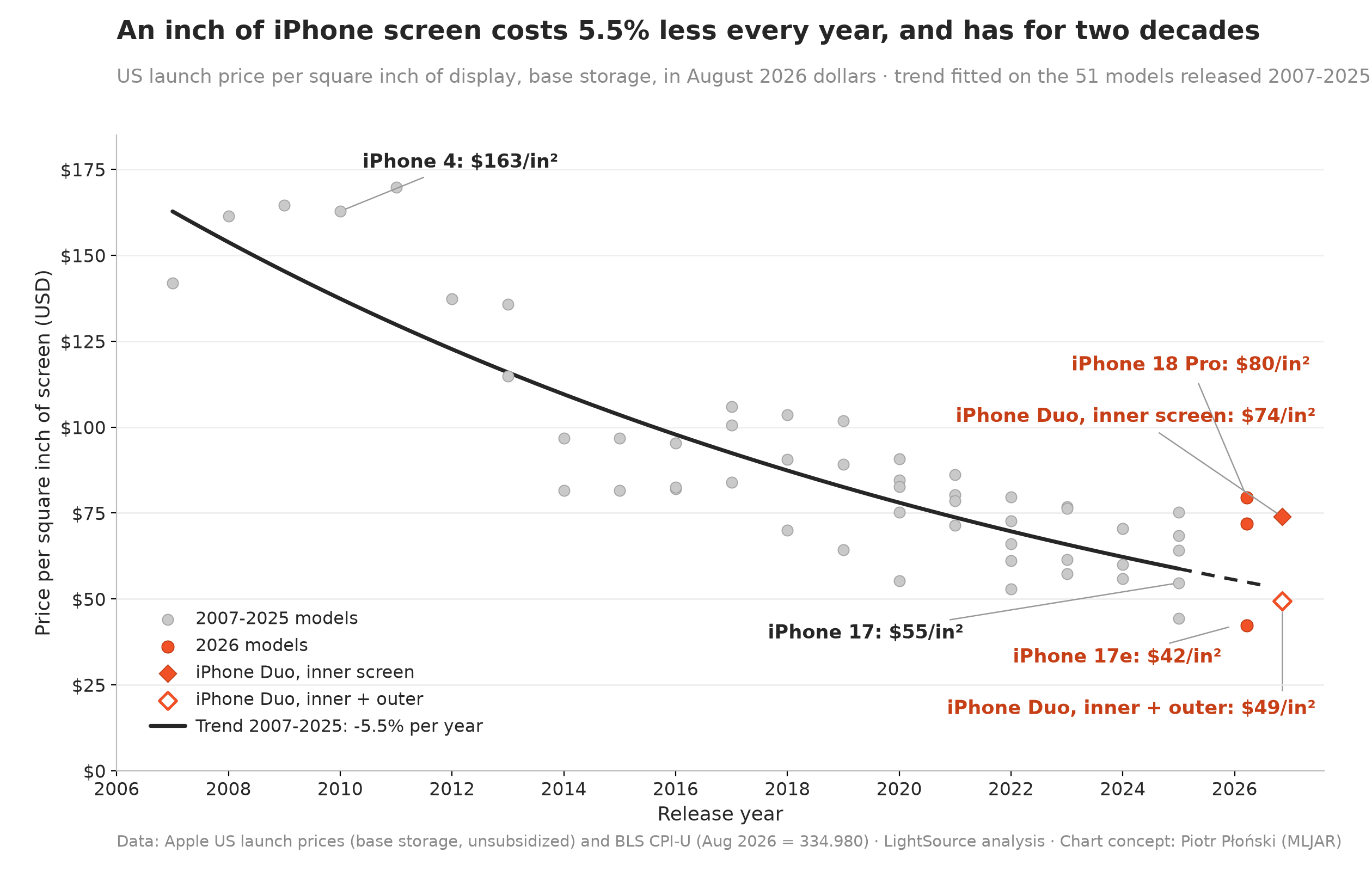
Every iPhone launch since 2007, priced per square inch of screen in August 2026 dollars; 2026 models in orange. Chart: LightSource analysis of Apple launch prices and BLS CPI-U, after Piotr Płoński (MLJAR).
The fit comes out to -5.50% per year, sustained across 19 years. The iPhone 4 cost $163 per square inch in today's dollars. The iPhone 17 costs $55. The 17e, at its March launch price, costs $42. Even this month's price increases mostly returned the lineup to the long-run trendline rather than breaking above it: the iPhone 18 Pro's $80 per square inch is roughly what the curve predicted a Pro-tier phone would cost.
The iPhone Duo is the entertaining data point. Measured against its 7.6-inch inner display alone, the $1,999 foldable runs $74 per square inch, priced like a Pro. Count both of its screens and it lands at $49, below the extrapolated trend. Apple's most expensive iPhone ever is, per square inch of glass it ships, one of its cheaper phones. That is either a clever way to launder a $2,000 price tag or evidence that the curve still governs how Apple prices hardware, and it is probably both.

The iPhone Duo's 5.4-inch outer and 7.6-inch inner displays. Counting both panels, the $1,999 foldable prices out at $49 per square inch of screen, under the 20-year trendline -- Source: Apple
Price per square inch is a deliberately crude metric, and it is worth being honest about its limits. It rewards big phones, penalizes miniaturization, and says nothing about cameras, batteries, or the computer inside. When the iPhone 6 replaced the 5s at the same $649, the inflation-adjusted price fell about 2% while price per square inch fell 29%, mostly because the screen got bigger; the curve mixes manufacturing progress with product-mix choices, and you cannot hand it to a supplier and demand 5.5% a year. But as a measure of consumer value, the crudeness cuts in a conservative direction. The Federal Reserve built quality-adjusted smartphone price indexes in 2019, factoring in processor speed, resolution, and cameras, and its revenue-weighted specification fell 16% per year from 2010 to 2018. Measured properly, the deflation is steeper than the chart shows, because the product inside the glass kept improving:
The original iPhone shipped with 4GB of storage for $499, which is $802 in August 2026 dollars. A $699 iPhone 17e ships with 256GB. Storage per inflation-adjusted dollar improved roughly 74-fold.
The display went from 480x320 at 163 ppi to 2622x1206 at 460 ppi on the 18 Pro: about 21 times the pixels at nearly triple the density, with double the typical peak brightness of an iPhone 4.
The camera went from a single 2-megapixel sensor with no flash to three 48-megapixel sensors plus an 18-megapixel front camera, and this year a mechanical variable aperture.
The radio went from EDGE to 5G with mmWave, and the battery from 8 hours of talk time to 36 hours of video playback, by Apple's own specs.
Put simply: the original iPhone gave you half a gigabyte of storage per hundred inflation-adjusted dollars, and a 17e gives you more than 36. The reasonable question is where two decades of compounding like that actually comes from.
Scale, Supplier Learning Curves, and Component Competition Drove the Curve Down
Less of the answer lives in Cupertino's design studio than you would guess, because most of it lives in the industrial base underneath. Apple ships on the order of 230 million iPhones a year, and that volume did three things at once. It filled entire display fabs, NAND lines, and camera-module plants, letting suppliers amortize capital over enormous runs. It marched components down their learning curves, with each doubling of cumulative volume dropping unit cost a predictable percentage. And it kept multiple suppliers bidding for the same socket year after year, because losing the iPhone slot could idle a factory.
I watched a version of this from the inside at Tesla, where the Model 3 ramp bent around whichever component was scarce that quarter. The lesson that stuck with me is that sustained cost decline at that scale is a system you construct rather than a discount anyone grants you: suppliers' capex plans and your product roadmap get negotiated together, years ahead. My colleague Aparna Keswani has written about where AI now helps in that construction, and the mechanics of decomposing a product's cost this way are the core of should-cost analysis; we published a practitioner's guide for consumer electronics that walks through the method.
I wrote last week about the other side of this machine: the supply base Apple built in Shenzhen ended up powering its Chinese competitors' rise. The same industrial commons that made six of the top eight phone makers Chinese is what made the cost curve above possible. Two decades of that work compounds into what looks like magic on a chart, and up close it is purchase orders, tooling loans, and yield negotiations.
Memory Went From 10% of the iPhone's Build Cost to 34% in One Year
That system is now being outbid.
The numbers coming out of the memory market over the past twelve months are unlike anything in the industry's cyclical history. Conventional DRAM contract prices rose 93-98% quarter-over-quarter in the first quarter of 2026, per TrendForce, and another 58-63% in the second. TechInsights tracks a 12GB LPDDR5 package, the kind of part that goes into a flagship phone, going from about $140 in June 2026 to $165 by September, with $183 projected for next March. SK hynix announced in late 2025 that its entire 2026 output, DRAM and NAND both, was already sold out. Samsung is ending LPDDR4 production altogether; one legacy LPDDR4X part went from roughly $6 to $28 in ten months.
The cause is not smartphone demand but the rate at which AI servers eat memory wafers. Micron told investors that HBM, the stacked memory that feeds GPUs, consumes about three times the wafer capacity per bit of standard DDR5, and the ratio worsens with each HBM generation. And the crossover is no longer confined to exotic parts: AI servers now consume phone-class LPDDR5X directly. A single 256GB Micron SOCAMM2 module, built for Nvidia servers, contains as much memory as 21 flagship phones. TrendForce estimates AI demand will consume around a fifth of global DRAM supply in 2026 on wafer terms, and every fab is reallocating toward it.
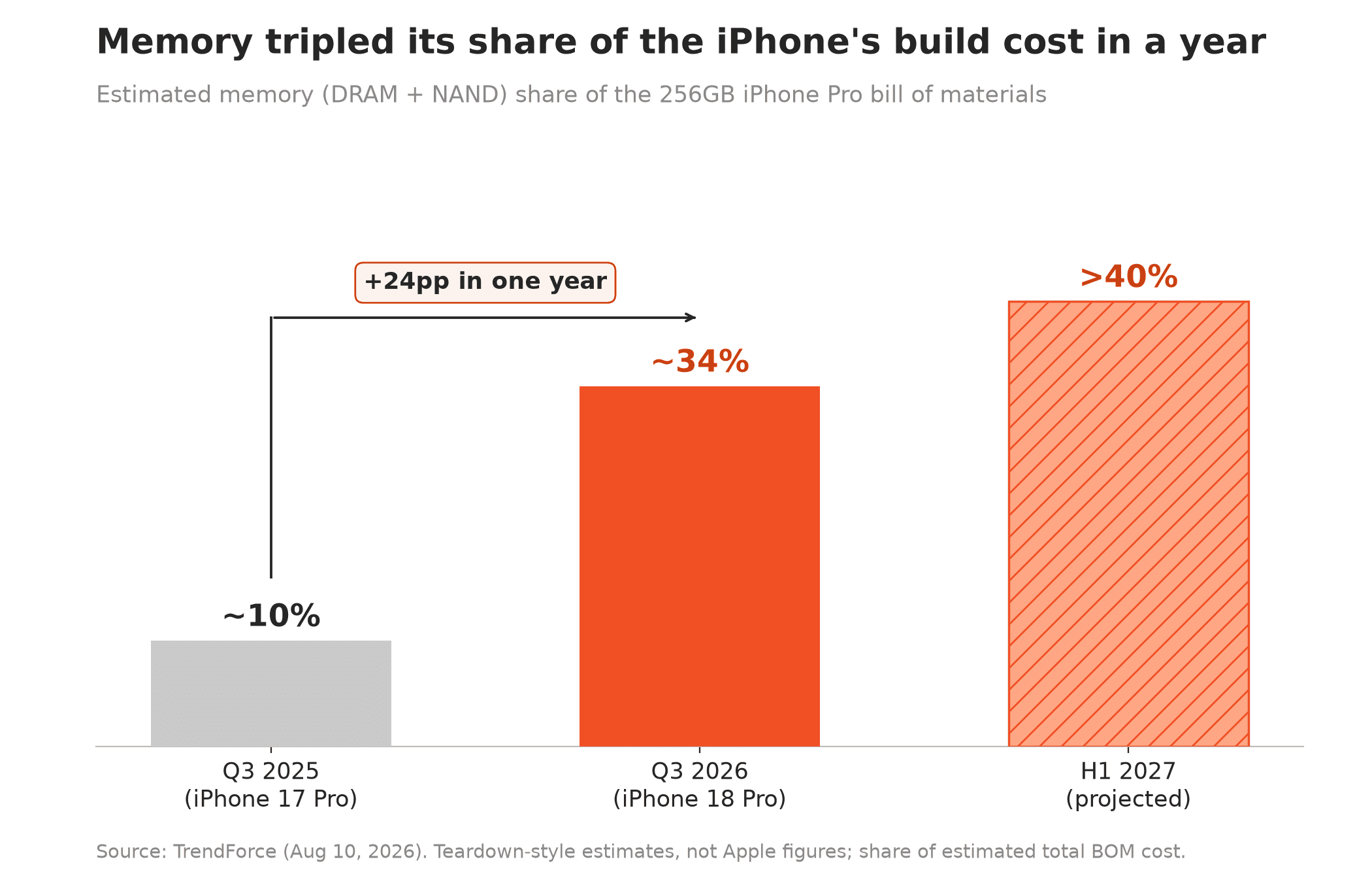
Memory's estimated share of the iPhone Pro bill of materials, per TrendForce: roughly 10% in Q3 2025 to roughly 34% in Q3 2026, projected past 40% in the first half of 2027.
For the iPhone specifically, TrendForce's estimate is that memory went from roughly 10% of the 17 Pro's bill of materials in late 2025 to about 34% of the 18 Pro's a year later, on its way past 40% by mid-2027, with the 256GB iPhone 18 Pro's total estimated BOM up around 38% year over year. Treat all teardown-style numbers as estimates; Cook once said of them, "I've never seen one that's even close to accurate." But the direction is confirmed by Apple's own guidance and by where it put the price increases. The base 18 Pro went up $100. The 1TB tier went up $300. Apple pushed the recovery into exactly the storage tiers where NAND inflation lives, and analysts at Counterpoint still model the 18 Pro Max at a slightly lower gross margin than its predecessor even after the increases. Apple is absorbing more of the increase than it is passing through.
There is a structural detail here that every procurement person should sit with. The hyperscalers buying memory for data centers signed multi-year long-term agreements early, which cap their own price increases. TrendForce's read of the third-quarter market is that suppliers therefore concentrate price hikes on whoever lacks an LTA, which mostly means phone and PC makers. The allocation queue that formed in 2026 runs data centers first, then automotive, then PCs, then smartphones. Being the release valve in someone else's seller's market is an expensive place to stand.
Nvidia Overtook Apple as TSMC's Biggest Customer in 2025
The logic side of the story is more nuanced than the memory side, and worth getting right.
The headline facts: in 2020, smartphones were about 48% of TSMC's revenue and high-performance computing about 31%. By the second quarter of 2026, HPC was 66% and smartphones 22%. In 2025, by analyst Dan Nystedt's math, Nvidia passed Apple as TSMC's largest customer, at over 19% of revenue against Apple's 17%. Apple had held that seat for a decade. Those are revenue classifications, not wafer counts, but the direction is unambiguous: the leading edge's center of gravity moved from the phone in your pocket to the data-center buildout whose lead times now run in years.
What AI demand has not done, so far, is price the iPhone off the leading edge. Apple remains TSMC's first customer on each new node, and reportedly locked up more than half of the first-year capacity of the 2nm N2 process for the A20 Pro, the chip in the iPhone 18 lineup, just as it bought essentially all of TSMC's first-year 3nm output in 2023, on terms where it reportedly paid only for known good dies while yields matured. The cost is real: 2nm wafers reportedly run about $30,000 against $25,000-27,000 for 3nm, and analysts estimate the A20 Pro costs Apple roughly double what the A19 did. Silicon has been climbing as a share of the phone's cost for years, from $45 for an A15 to an estimated $135 for an A18 Pro.
But there is an honest counter-argument that the AI boom is subsidizing the platform phones ride on, not just raiding it. TSMC raised its 2026 capital budget to $60-64 billion, absorbed 3-4 points of margin dilution from the N2 ramp, and still posted record profitability, because AI demand is paying for the fabs. The catch is timing: that investment helps future phone generations, while this year's purchasing teams have to win output from the factories that already exist. Wafer competition is a queue Apple knows how to manage; my point is narrower. The genuine crowding-out is in memory, where the physics of HBM consumes the same wafers phones need. In logic, the picture is closer to what I described when Google sold a million TPUs to its own competitor: capacity gets allocated by relationship and commitment as much as by price. The machines that build all of this remain the deepest moat; we mapped that world in our piece on ASML's 5,100-supplier machine.
Apple's Playbook: Prepay Billions, Buy the Node, Own the Tooling
So how does a phone company keep winning allocation fights against buyers with deeper capex budgets? Apple has been rehearsing for this exact market for twenty years, and its playbook is unusually well documented in its own filings.
Year | Move | Amount | What it bought |
|---|---|---|---|
1998 | Air freight buyout | ~$100M | Holiday shipping capacity rivals couldn't get |
2005 | NAND prepayment | $1.25B | Flash from five suppliers through 2010 |
2009 | LG Display advance | $500M | Five-year panel supply |
2011 | Component prepays | $3.9B | A "very strategic" component, two years |
2013 | GT Advanced | $578M | Sapphire capacity (failed) |
2023 | TSMC N3 buyout | n/a | ~All first-year 3nm output |
2025 | US manufacturing | $600B/4yr | Glass, sensors, chips, rare earths |
2026 | Broadcom expansion | $1.5B capex | Fort Collins chip capacity |
The pattern predates the iPhone. In 1998, months after joining, Tim Cook pre-bought about $100 million of holiday air freight before the iMac shipped, locking rivals out of the planes. In November 2005, Apple wired $1.25 billion to Hynix, Intel, Micron, Samsung, and Toshiba to secure NAND flash through 2010; Steve Jobs's stated reason was making "as many of our wildly popular iPods as the market demands." The 2009 LG Display deal shows up in LG's own SEC filings as a $500 million advance against five years of panels. By late 2011 Apple was carrying $2.9 billion of component prepayments on its balance sheet.
The quieter mechanism is that Apple buys capacity and capability, not just parts. Its 10-K discloses that Apple owns "product tooling and manufacturing process equipment" sitting inside its suppliers' plants, and its manufacturing purchase obligations stood at $56.2 billion in the fiscal 2025 filing. The Advanced Manufacturing Fund started at $1 billion in 2017, went to $5 billion, and funded Corning's glass lines and Finisar's Face ID lasers; its successor, the $600 billion four-year US commitment announced in August 2025, wraps chips from TSMC Arizona, cover glass from Kentucky, and, per December reporting, iPhone 18 camera sensors from Samsung's Austin fab, the first break in Sony's two-decade exclusivity. In July, Apple committed spend that lets Broadcom put $1.5 billion of capital into its Fort Collins fab. The prepayments buy priority: the company that funded the capacity is the first one served from it.
It does not always work. In 2013 Apple prepaid GT Advanced Technologies up to $578 million to grow sapphire for iPhone screens; GT missed its milestones, filed for Chapter 11 in October 2014, and repaid Apple over four years by auctioning two thousand furnaces. Prepaying a supplier creates supply only if the supplier can actually make the thing. Underwriting capacity means underwriting execution risk too, and Apple ate that one in public.
Which makes the reported next move interesting. TrendForce reported this month that Apple has signed a long-term NAND supply agreement, with market watchers naming Kioxia as the likely partner; the reported three-to-five-year term without a price cap is, so far, market speculation, and none of the parties have confirmed terms. If the no-cap detail holds, it is a real shift. Apple spent two decades using multi-sourcing to squeeze memory suppliers on price. Trading price protection for guaranteed allocation is what buyers do when they conclude that availability, not cost, has become the binding constraint. It is worth being precise about what such deals actually fix: one contract can guarantee quantity while the price floats, another can fix price while delivery stays soft, and both get casually described as "locking in supply" even though they behave completely differently in a shortage. Kioxia's CEO, for his part, says customers are now asking for supply agreements running to 2030 and that half his volume will soon sit under LTAs; he has also told his sales team not to chase the highest possible prices, because breaking your customers' economics eventually breaks your own order book.
Samsung Makes Its Own Memory and Its Phone Division Still Lost Money
If you want a control group for Apple's approach, 2026 has been running the experiment.
Samsung would seem to hold the best hand in this market, since it is the world's largest memory maker. Its memory business did post record quarterly revenue and operating profit in Q2 2026. Its phone division did not share in the protection: the mobile and networks unit lost 0.7 trillion won on 33.2 trillion won of revenue the same quarter, with Samsung itself citing elevated component costs. Vertical integration hedged the conglomerate's economics and still failed to insulate the phone P&L, because the memory division sells at market prices, including to its own colleagues down the hall.
Downmarket, the choices get starker. Xiaomi raised prices on already-shipping phones in Japan by up to 25% in September, citing memory costs it could no longer absorb. Counterpoint's September data has existing smartphone models repricing about 15% globally this year, with new launches about 25% above their predecessors. And the spec sheet is quietly becoming the shock absorber: TrendForce expects 12GB to replace 16GB as the premium standard while mid-range phones fall back to 8GB, holding 2026's average phone to about 8.5GB of DRAM even as on-device AI features ask for more. There is a loop in that sentence worth noticing: the AI boom eating the memory supply is the same force that makes phones want more memory. Memory is now over 30% of a premium phone's estimated build cost, and closer to 60% on a sub-$400 device, which is why the crunch will hit budget buyers hardest. When Oppo and vivo reportedly declined Samsung's third-quarter memory price offer, it read less like a negotiating position than like sticker shock.
What Buyers Without Apple's Balance Sheet Can Take From This
Almost nobody reading this can buy out a TSMC node. But the mechanics underneath Apple's playbook scale down further than most teams assume, and the last big shortage taught us what failure looks like. During 2020-2022, automakers cancelled chip orders in the demand trough, and, as McKinsey documented afterward, their binding purchase commitments ran weeks to months while other industries were signing years. When demand snapped back, the queue position they had surrendered took years to win back. The factory plans in years; if you commit in weeks, you are buying a place at the back of the line.
The transferable moves, roughly in order of difficulty:
Negotiate allocation separately from price. A great price on an unfulfilled order is not supply. Specify quantities, sites, confirmation windows, and what happens in a shortage, the way the hyperscalers' memory LTAs do.
Buy bounded commitments, not unlimited bets. A firm near-term quantity plus capacity options beats putting your whole optimistic forecast under take-or-pay. TrendForce already flags phone brands at risk of failing their own LTA volume commitments as targets slip. The 2011 earthquake scare is the cautionary tale in the other direction: mainstream NAND prices fell 8-16% within about six weeks of the panic-buying peak, and whoever bought the top rode the inventory down.
Index the price, collar the risk. If a supplier won't cap price, negotiate a benchmark, a reset cadence, and a floor-and-ceiling. Know which risk each side is holding and what you received for it.
Multi-source the bottleneck, not the invoice. Kioxia and Sandisk share a manufacturing joint venture; two logos on your approved-vendor list, one set of fabs. My colleague Andy Hunt wrote about this convergence problem, and it is the most common false comfort in dual sourcing.
Design to availability before the shortage. Prequalify alternate memory densities and suppliers while parts are available. Requalification takes months, and an allocation cut arrives with a phone call.
Put commercial exposure next to the engineering BOM. For every critical part: contracted cost versus market, committed versus uncommitted volume, contract expiry, qualified alternates, and switching time. Most teams cannot answer those six questions today for their top twenty parts.
The arithmetic behind these moves is worth doing explicitly, because reservation premiums look expensive until you price the alternative. If a launch plans 10,000 units at $200 contribution each and a component shortage would cost 500 of those sales, that is $100,000 of contribution at risk; a $5-per-unit reservation premium across the build costs $50,000. Whether that trade is good depends on whether the lost sales are really lost or merely delayed, which is a question procurement and finance have to answer together, before the shortage answers it for them.
That last one is where our customers live. LightSource customers, mostly challenger manufacturers who cannot out-prepay anyone, run their BOMs with live cost and capacity visibility, so when a component category moves the way memory just did, they can see which products carry the exposure and re-quote the affected parts in days rather than quarters. The playbook above only works if you know where you are exposed before the market tells you.
The spring 2027 iPhone 18 will be the honest test of the twenty-year curve, the first mainstream iPhone priced entirely inside the memory crunch, against TrendForce's projection of memory passing 40% of build cost. My bet is that the curve bends rather than breaks; Apple has spent twenty years building the machine that defends it, and the machine has survived floods, an earthquake, a pandemic, and a bankruptcy. But the curve's next opponent is the largest capital deployment in the history of the technology industry, and for the first time the other bidder needs the same wafers. I will be watching where the 2027 dots land.
Sources
Apple debuts iPhone 18 Pro and iPhone 18 Pro Max -- official announcement, pricing and A20 Pro details
Apple unveils iPhone Duo -- the foldable's specs and pricing
MacRumors: Apple raises prices of iPhone 16, 17, Air, and 17e -- the same-day repricing of shipping models
MacRumors: Tim Cook on Apple's price increases -- the "100-year flood" quote and margin guidance
Piotr Plonski (MLJAR): Are iPhones Really More Expensive? -- the original price-per-square-inch analysis
BLS CPI-U / FRED CPIAUCNS -- inflation adjustment series (Aug 2026 = 334.980)
TrendForce: iPhone 18 Pro BOM cost expected to surge nearly 40% -- memory's share of build cost, 10% to 34% to 40%+
TrendForce: 1Q26 DRAM industry revenue up 81% QoQ -- the 93-98% contract price increases
Micron Q1 FY2026 earnings call -- HBM's 3:1 wafer trade ratio
Micron SOCAMM2 product page -- 256GB LPDDR5X server modules
TechInsights: iPhone 18 memory costs -- LPDDR5/NAND package price tracking
Counterpoint: iPhone 17 Pro Max vs 18 Pro Max BoM comparison -- component cost and margin modeling
TSMC Q2 2026 earnings transcript -- $60-64B capex, N2 margin dilution
CNBC: Nvidia overtakes Apple as TSMC's largest customer -- customer mix analysis (Dan Nystedt)
Apple: Long-term supply agreements for flash memory (2005) -- the $1.25B NAND prepayment
Apple: $600 billion US commitment and American Manufacturing Program -- Corning, TSMC Arizona, supplier capex
Apple: Increased spend with Broadcom -- the $1.5B Fort Collins expansion
MIT Technology Review: GT Advanced declares bankruptcy -- the failure case
TrendForce: Apple said to have signed NAND LTA -- the reported Kioxia agreement (terms unconfirmed)
Samsung Q2 2026 results -- record memory, mobile division loss
Android Authority: Xiaomi price hikes in Japan -- repricing of shipping phones
McKinsey: Coping with the auto semiconductor shortage -- the commitment-horizon failure
Federal Reserve: smartphone price indexes (2019) -- quality-adjusted deflation of 16%/yr
Frequently Asked Questions
Why did Apple raise iPhone prices in 2026?
Memory costs. DRAM and NAND contract prices roughly doubled in early 2026 as AI data centers absorbed memory fab capacity, and TrendForce estimates memory went from about 10% to about 34% of the iPhone's build cost in a year. Apple raised the iPhone 18 Pro $100 at the base tier and $300 at the 1TB tier, and raised prices on already-shipping models like the iPhone 17 and 17e by $100 -- while still absorbing enough cost that analysts model the 18 Pro Max at a slightly lower gross margin than its predecessor.
What does the iPhone price-per-square-inch chart show?
It divides each iPhone's inflation-adjusted US launch price by its display area. Across the 51 models released from 2007 to 2025, that figure fell about 5.5% per year -- from $163 per square inch for the iPhone 4 to $55 for the iPhone 17, in constant August 2026 dollars. It is a rough proxy for hardware value, and quality-adjusted indexes (like the Federal Reserve's, which fell 16% annually from 2010-2018) suggest it understates the real deflation.
Is the iPhone really competing with data centers for chips?
For memory, directly: HBM for AI GPUs consumes about three times the wafer capacity per bit of standard DRAM, AI servers now use phone-class LPDDR5X in modules holding as much memory as 21 flagship phones, and suppliers prioritize data-center allocation. For leading-edge logic, less so -- Apple still books the first year of each new TSMC node, and AI demand funds the fabs phones use. The squeeze is real but concentrated in memory and storage.
How does Apple secure chip and memory supply?
A twenty-year playbook: multi-billion-dollar prepayments (starting with $1.25B for NAND in 2005), buying out first-year capacity of new TSMC nodes, paying only for known good dies while yields mature, funding supplier factories and owning the tooling inside them, and $56 billion in standing manufacturing purchase obligations. In 2026 it reportedly added a multi-year NAND long-term agreement, trading price protection for guaranteed allocation.
What is a long-term agreement (LTA) in procurement?
A contract committing a buyer and supplier to volumes, and often pricing mechanisms, over multiple years rather than purchase order by purchase order. In the 2026 memory market, LTAs became the dividing line: hyperscalers who signed them early capped their price increases, while buyers without them -- mostly phone and PC makers -- absorbed the steepest hikes and the last place in the allocation queue.
What should smaller manufacturers do about the memory shortage?
Six moves scale down from Apple's playbook: negotiate allocation terms separately from price; commit to bounded volumes with capacity options rather than take-or-pay bets; index prices with floors and ceilings; verify whether your "dual sources" share fabs or upstream suppliers; prequalify alternate parts before shortages hit; and maintain live visibility into which products carry exposure to which components, so repricing and requoting take days instead of quarters.
On September 9, Apple did something it had never done in the iPhone era: it raised the prices of phones it was already selling. The iPhone 17, six months into its run, went from $799 to $899. The iPhone Air went to $1,099. The budget 17e, launched in March at $599, quietly became a $699 phone. This happened the same morning Apple introduced the iPhone 18 Pro at $1,199, a $100 increase over last year's Pro, and its first foldable, the $1,999 iPhone Duo.
Repricing shipping products is the kind of move you see from commodity distributors, not from the most disciplined pricing organization in consumer electronics. Tim Cook had already told investors why on the July 30 earnings call: "We reluctantly raised prices," he said, describing "a 100-year flood on memory pricing with exponential increases." Apple guided its September-quarter gross margin down to 47-48%, from 50.1% the quarter before.
I run a procurement software company, so I read iPhone launches the way other people read box scores. And the September 9 event was the most interesting supply-chain story Apple has told in years, for two reasons. The first is a chart that has been making the rounds since data scientist Piotr Plonski posted it to r/dataisbeautiful: two decades of iPhone prices, adjusted for inflation and divided by screen area, falling in a nearly perfect exponential. The second is the force now pushing against that curve. For the first time in the product's history, the iPhone is bidding against AI data centers for the wafers, memory, and packaging capacity it is built from.
We rebuilt Plonski's chart from scratch to check it, and then went looking for what sits underneath it. Here is what the data says.
An Inch of iPhone Screen Has Gotten 5.5% Cheaper Every Year Since 2007
We collected the US launch price of all 51 iPhone models released from 2007 through 2025 (base storage, full unsubsidized retail, which matters for the early carrier-contract years), converted each to August 2026 dollars using the BLS CPI-U index for its release month, and divided by the display's actual area computed from Apple's own diagonal and resolution specs. Then we fit a trend.
Every iPhone launch since 2007, priced per square inch of screen in August 2026 dollars; 2026 models in orange. Chart: LightSource analysis of Apple launch prices and BLS CPI-U, after Piotr Płoński (MLJAR).
The fit comes out to -5.50% per year, sustained across 19 years. The iPhone 4 cost $163 per square inch in today's dollars. The iPhone 17 costs $55. The 17e, at its March launch price, costs $42. Even this month's price increases mostly returned the lineup to the long-run trendline rather than breaking above it: the iPhone 18 Pro's $80 per square inch is roughly what the curve predicted a Pro-tier phone would cost.
The iPhone Duo is the entertaining data point. Measured against its 7.6-inch inner display alone, the $1,999 foldable runs $74 per square inch, priced like a Pro. Count both of its screens and it lands at $49, below the extrapolated trend. Apple's most expensive iPhone ever is, per square inch of glass it ships, one of its cheaper phones. That is either a clever way to launder a $2,000 price tag or evidence that the curve still governs how Apple prices hardware, and it is probably both.
The iPhone Duo's 5.4-inch outer and 7.6-inch inner displays. Counting both panels, the $1,999 foldable prices out at $49 per square inch of screen, under the 20-year trendline -- Source: Apple
Price per square inch is a deliberately crude metric, and it is worth being honest about its limits. It rewards big phones, penalizes miniaturization, and says nothing about cameras, batteries, or the computer inside. When the iPhone 6 replaced the 5s at the same $649, the inflation-adjusted price fell about 2% while price per square inch fell 29%, mostly because the screen got bigger; the curve mixes manufacturing progress with product-mix choices, and you cannot hand it to a supplier and demand 5.5% a year. But as a measure of consumer value, the crudeness cuts in a conservative direction. The Federal Reserve built quality-adjusted smartphone price indexes in 2019, factoring in processor speed, resolution, and cameras, and its revenue-weighted specification fell 16% per year from 2010 to 2018. Measured properly, the deflation is steeper than the chart shows, because the product inside the glass kept improving:
The original iPhone shipped with 4GB of storage for $499, which is $802 in August 2026 dollars. A $699 iPhone 17e ships with 256GB. Storage per inflation-adjusted dollar improved roughly 74-fold.
The display went from 480x320 at 163 ppi to 2622x1206 at 460 ppi on the 18 Pro: about 21 times the pixels at nearly triple the density, with double the typical peak brightness of an iPhone 4.
The camera went from a single 2-megapixel sensor with no flash to three 48-megapixel sensors plus an 18-megapixel front camera, and this year a mechanical variable aperture.
The radio went from EDGE to 5G with mmWave, and the battery from 8 hours of talk time to 36 hours of video playback, by Apple's own specs.
Put simply: the original iPhone gave you half a gigabyte of storage per hundred inflation-adjusted dollars, and a 17e gives you more than 36. The reasonable question is where two decades of compounding like that actually comes from.
Scale, Supplier Learning Curves, and Component Competition Drove the Curve Down
Less of the answer lives in Cupertino's design studio than you would guess, because most of it lives in the industrial base underneath. Apple ships on the order of 230 million iPhones a year, and that volume did three things at once. It filled entire display fabs, NAND lines, and camera-module plants, letting suppliers amortize capital over enormous runs. It marched components down their learning curves, with each doubling of cumulative volume dropping unit cost a predictable percentage. And it kept multiple suppliers bidding for the same socket year after year, because losing the iPhone slot could idle a factory.
I watched a version of this from the inside at Tesla, where the Model 3 ramp bent around whichever component was scarce that quarter. The lesson that stuck with me is that sustained cost decline at that scale is a system you construct rather than a discount anyone grants you: suppliers' capex plans and your product roadmap get negotiated together, years ahead. My colleague Aparna Keswani has written about where AI now helps in that construction, and the mechanics of decomposing a product's cost this way are the core of should-cost analysis; we published a practitioner's guide for consumer electronics that walks through the method.
I wrote last week about the other side of this machine: the supply base Apple built in Shenzhen ended up powering its Chinese competitors' rise. The same industrial commons that made six of the top eight phone makers Chinese is what made the cost curve above possible. Two decades of that work compounds into what looks like magic on a chart, and up close it is purchase orders, tooling loans, and yield negotiations.
Memory Went From 10% of the iPhone's Build Cost to 34% in One Year
That system is now being outbid.
The numbers coming out of the memory market over the past twelve months are unlike anything in the industry's cyclical history. Conventional DRAM contract prices rose 93-98% quarter-over-quarter in the first quarter of 2026, per TrendForce, and another 58-63% in the second. TechInsights tracks a 12GB LPDDR5 package, the kind of part that goes into a flagship phone, going from about $140 in June 2026 to $165 by September, with $183 projected for next March. SK hynix announced in late 2025 that its entire 2026 output, DRAM and NAND both, was already sold out. Samsung is ending LPDDR4 production altogether; one legacy LPDDR4X part went from roughly $6 to $28 in ten months.
The cause is not smartphone demand but the rate at which AI servers eat memory wafers. Micron told investors that HBM, the stacked memory that feeds GPUs, consumes about three times the wafer capacity per bit of standard DDR5, and the ratio worsens with each HBM generation. And the crossover is no longer confined to exotic parts: AI servers now consume phone-class LPDDR5X directly. A single 256GB Micron SOCAMM2 module, built for Nvidia servers, contains as much memory as 21 flagship phones. TrendForce estimates AI demand will consume around a fifth of global DRAM supply in 2026 on wafer terms, and every fab is reallocating toward it.
Memory's estimated share of the iPhone Pro bill of materials, per TrendForce: roughly 10% in Q3 2025 to roughly 34% in Q3 2026, projected past 40% in the first half of 2027.
For the iPhone specifically, TrendForce's estimate is that memory went from roughly 10% of the 17 Pro's bill of materials in late 2025 to about 34% of the 18 Pro's a year later, on its way past 40% by mid-2027, with the 256GB iPhone 18 Pro's total estimated BOM up around 38% year over year. Treat all teardown-style numbers as estimates; Cook once said of them, "I've never seen one that's even close to accurate." But the direction is confirmed by Apple's own guidance and by where it put the price increases. The base 18 Pro went up $100. The 1TB tier went up $300. Apple pushed the recovery into exactly the storage tiers where NAND inflation lives, and analysts at Counterpoint still model the 18 Pro Max at a slightly lower gross margin than its predecessor even after the increases. Apple is absorbing more of the increase than it is passing through.
There is a structural detail here that every procurement person should sit with. The hyperscalers buying memory for data centers signed multi-year long-term agreements early, which cap their own price increases. TrendForce's read of the third-quarter market is that suppliers therefore concentrate price hikes on whoever lacks an LTA, which mostly means phone and PC makers. The allocation queue that formed in 2026 runs data centers first, then automotive, then PCs, then smartphones. Being the release valve in someone else's seller's market is an expensive place to stand.
Nvidia Overtook Apple as TSMC's Biggest Customer in 2025
The logic side of the story is more nuanced than the memory side, and worth getting right.
The headline facts: in 2020, smartphones were about 48% of TSMC's revenue and high-performance computing about 31%. By the second quarter of 2026, HPC was 66% and smartphones 22%. In 2025, by analyst Dan Nystedt's math, Nvidia passed Apple as TSMC's largest customer, at over 19% of revenue against Apple's 17%. Apple had held that seat for a decade. Those are revenue classifications, not wafer counts, but the direction is unambiguous: the leading edge's center of gravity moved from the phone in your pocket to the data-center buildout whose lead times now run in years.
What AI demand has not done, so far, is price the iPhone off the leading edge. Apple remains TSMC's first customer on each new node, and reportedly locked up more than half of the first-year capacity of the 2nm N2 process for the A20 Pro, the chip in the iPhone 18 lineup, just as it bought essentially all of TSMC's first-year 3nm output in 2023, on terms where it reportedly paid only for known good dies while yields matured. The cost is real: 2nm wafers reportedly run about $30,000 against $25,000-27,000 for 3nm, and analysts estimate the A20 Pro costs Apple roughly double what the A19 did. Silicon has been climbing as a share of the phone's cost for years, from $45 for an A15 to an estimated $135 for an A18 Pro.
But there is an honest counter-argument that the AI boom is subsidizing the platform phones ride on, not just raiding it. TSMC raised its 2026 capital budget to $60-64 billion, absorbed 3-4 points of margin dilution from the N2 ramp, and still posted record profitability, because AI demand is paying for the fabs. The catch is timing: that investment helps future phone generations, while this year's purchasing teams have to win output from the factories that already exist. Wafer competition is a queue Apple knows how to manage; my point is narrower. The genuine crowding-out is in memory, where the physics of HBM consumes the same wafers phones need. In logic, the picture is closer to what I described when Google sold a million TPUs to its own competitor: capacity gets allocated by relationship and commitment as much as by price. The machines that build all of this remain the deepest moat; we mapped that world in our piece on ASML's 5,100-supplier machine.
Apple's Playbook: Prepay Billions, Buy the Node, Own the Tooling
So how does a phone company keep winning allocation fights against buyers with deeper capex budgets? Apple has been rehearsing for this exact market for twenty years, and its playbook is unusually well documented in its own filings.
Year | Move | Amount | What it bought |
|---|---|---|---|
1998 | Air freight buyout | ~$100M | Holiday shipping capacity rivals couldn't get |
2005 | NAND prepayment | $1.25B | Flash from five suppliers through 2010 |
2009 | LG Display advance | $500M | Five-year panel supply |
2011 | Component prepays | $3.9B | A "very strategic" component, two years |
2013 | GT Advanced | $578M | Sapphire capacity (failed) |
2023 | TSMC N3 buyout | n/a | ~All first-year 3nm output |
2025 | US manufacturing | $600B/4yr | Glass, sensors, chips, rare earths |
2026 | Broadcom expansion | $1.5B capex | Fort Collins chip capacity |
The pattern predates the iPhone. In 1998, months after joining, Tim Cook pre-bought about $100 million of holiday air freight before the iMac shipped, locking rivals out of the planes. In November 2005, Apple wired $1.25 billion to Hynix, Intel, Micron, Samsung, and Toshiba to secure NAND flash through 2010; Steve Jobs's stated reason was making "as many of our wildly popular iPods as the market demands." The 2009 LG Display deal shows up in LG's own SEC filings as a $500 million advance against five years of panels. By late 2011 Apple was carrying $2.9 billion of component prepayments on its balance sheet.
The quieter mechanism is that Apple buys capacity and capability, not just parts. Its 10-K discloses that Apple owns "product tooling and manufacturing process equipment" sitting inside its suppliers' plants, and its manufacturing purchase obligations stood at $56.2 billion in the fiscal 2025 filing. The Advanced Manufacturing Fund started at $1 billion in 2017, went to $5 billion, and funded Corning's glass lines and Finisar's Face ID lasers; its successor, the $600 billion four-year US commitment announced in August 2025, wraps chips from TSMC Arizona, cover glass from Kentucky, and, per December reporting, iPhone 18 camera sensors from Samsung's Austin fab, the first break in Sony's two-decade exclusivity. In July, Apple committed spend that lets Broadcom put $1.5 billion of capital into its Fort Collins fab. The prepayments buy priority: the company that funded the capacity is the first one served from it.
It does not always work. In 2013 Apple prepaid GT Advanced Technologies up to $578 million to grow sapphire for iPhone screens; GT missed its milestones, filed for Chapter 11 in October 2014, and repaid Apple over four years by auctioning two thousand furnaces. Prepaying a supplier creates supply only if the supplier can actually make the thing. Underwriting capacity means underwriting execution risk too, and Apple ate that one in public.
Which makes the reported next move interesting. TrendForce reported this month that Apple has signed a long-term NAND supply agreement, with market watchers naming Kioxia as the likely partner; the reported three-to-five-year term without a price cap is, so far, market speculation, and none of the parties have confirmed terms. If the no-cap detail holds, it is a real shift. Apple spent two decades using multi-sourcing to squeeze memory suppliers on price. Trading price protection for guaranteed allocation is what buyers do when they conclude that availability, not cost, has become the binding constraint. It is worth being precise about what such deals actually fix: one contract can guarantee quantity while the price floats, another can fix price while delivery stays soft, and both get casually described as "locking in supply" even though they behave completely differently in a shortage. Kioxia's CEO, for his part, says customers are now asking for supply agreements running to 2030 and that half his volume will soon sit under LTAs; he has also told his sales team not to chase the highest possible prices, because breaking your customers' economics eventually breaks your own order book.
Samsung Makes Its Own Memory and Its Phone Division Still Lost Money
If you want a control group for Apple's approach, 2026 has been running the experiment.
Samsung would seem to hold the best hand in this market, since it is the world's largest memory maker. Its memory business did post record quarterly revenue and operating profit in Q2 2026. Its phone division did not share in the protection: the mobile and networks unit lost 0.7 trillion won on 33.2 trillion won of revenue the same quarter, with Samsung itself citing elevated component costs. Vertical integration hedged the conglomerate's economics and still failed to insulate the phone P&L, because the memory division sells at market prices, including to its own colleagues down the hall.
Downmarket, the choices get starker. Xiaomi raised prices on already-shipping phones in Japan by up to 25% in September, citing memory costs it could no longer absorb. Counterpoint's September data has existing smartphone models repricing about 15% globally this year, with new launches about 25% above their predecessors. And the spec sheet is quietly becoming the shock absorber: TrendForce expects 12GB to replace 16GB as the premium standard while mid-range phones fall back to 8GB, holding 2026's average phone to about 8.5GB of DRAM even as on-device AI features ask for more. There is a loop in that sentence worth noticing: the AI boom eating the memory supply is the same force that makes phones want more memory. Memory is now over 30% of a premium phone's estimated build cost, and closer to 60% on a sub-$400 device, which is why the crunch will hit budget buyers hardest. When Oppo and vivo reportedly declined Samsung's third-quarter memory price offer, it read less like a negotiating position than like sticker shock.
What Buyers Without Apple's Balance Sheet Can Take From This
Almost nobody reading this can buy out a TSMC node. But the mechanics underneath Apple's playbook scale down further than most teams assume, and the last big shortage taught us what failure looks like. During 2020-2022, automakers cancelled chip orders in the demand trough, and, as McKinsey documented afterward, their binding purchase commitments ran weeks to months while other industries were signing years. When demand snapped back, the queue position they had surrendered took years to win back. The factory plans in years; if you commit in weeks, you are buying a place at the back of the line.
The transferable moves, roughly in order of difficulty:
Negotiate allocation separately from price. A great price on an unfulfilled order is not supply. Specify quantities, sites, confirmation windows, and what happens in a shortage, the way the hyperscalers' memory LTAs do.
Buy bounded commitments, not unlimited bets. A firm near-term quantity plus capacity options beats putting your whole optimistic forecast under take-or-pay. TrendForce already flags phone brands at risk of failing their own LTA volume commitments as targets slip. The 2011 earthquake scare is the cautionary tale in the other direction: mainstream NAND prices fell 8-16% within about six weeks of the panic-buying peak, and whoever bought the top rode the inventory down.
Index the price, collar the risk. If a supplier won't cap price, negotiate a benchmark, a reset cadence, and a floor-and-ceiling. Know which risk each side is holding and what you received for it.
Multi-source the bottleneck, not the invoice. Kioxia and Sandisk share a manufacturing joint venture; two logos on your approved-vendor list, one set of fabs. My colleague Andy Hunt wrote about this convergence problem, and it is the most common false comfort in dual sourcing.
Design to availability before the shortage. Prequalify alternate memory densities and suppliers while parts are available. Requalification takes months, and an allocation cut arrives with a phone call.
Put commercial exposure next to the engineering BOM. For every critical part: contracted cost versus market, committed versus uncommitted volume, contract expiry, qualified alternates, and switching time. Most teams cannot answer those six questions today for their top twenty parts.
The arithmetic behind these moves is worth doing explicitly, because reservation premiums look expensive until you price the alternative. If a launch plans 10,000 units at $200 contribution each and a component shortage would cost 500 of those sales, that is $100,000 of contribution at risk; a $5-per-unit reservation premium across the build costs $50,000. Whether that trade is good depends on whether the lost sales are really lost or merely delayed, which is a question procurement and finance have to answer together, before the shortage answers it for them.
That last one is where our customers live. LightSource customers, mostly challenger manufacturers who cannot out-prepay anyone, run their BOMs with live cost and capacity visibility, so when a component category moves the way memory just did, they can see which products carry the exposure and re-quote the affected parts in days rather than quarters. The playbook above only works if you know where you are exposed before the market tells you.
The spring 2027 iPhone 18 will be the honest test of the twenty-year curve, the first mainstream iPhone priced entirely inside the memory crunch, against TrendForce's projection of memory passing 40% of build cost. My bet is that the curve bends rather than breaks; Apple has spent twenty years building the machine that defends it, and the machine has survived floods, an earthquake, a pandemic, and a bankruptcy. But the curve's next opponent is the largest capital deployment in the history of the technology industry, and for the first time the other bidder needs the same wafers. I will be watching where the 2027 dots land.
Sources
Apple debuts iPhone 18 Pro and iPhone 18 Pro Max -- official announcement, pricing and A20 Pro details
Apple unveils iPhone Duo -- the foldable's specs and pricing
MacRumors: Apple raises prices of iPhone 16, 17, Air, and 17e -- the same-day repricing of shipping models
MacRumors: Tim Cook on Apple's price increases -- the "100-year flood" quote and margin guidance
Piotr Plonski (MLJAR): Are iPhones Really More Expensive? -- the original price-per-square-inch analysis
BLS CPI-U / FRED CPIAUCNS -- inflation adjustment series (Aug 2026 = 334.980)
TrendForce: iPhone 18 Pro BOM cost expected to surge nearly 40% -- memory's share of build cost, 10% to 34% to 40%+
TrendForce: 1Q26 DRAM industry revenue up 81% QoQ -- the 93-98% contract price increases
Micron Q1 FY2026 earnings call -- HBM's 3:1 wafer trade ratio
Micron SOCAMM2 product page -- 256GB LPDDR5X server modules
TechInsights: iPhone 18 memory costs -- LPDDR5/NAND package price tracking
Counterpoint: iPhone 17 Pro Max vs 18 Pro Max BoM comparison -- component cost and margin modeling
TSMC Q2 2026 earnings transcript -- $60-64B capex, N2 margin dilution
CNBC: Nvidia overtakes Apple as TSMC's largest customer -- customer mix analysis (Dan Nystedt)
Apple: Long-term supply agreements for flash memory (2005) -- the $1.25B NAND prepayment
Apple: $600 billion US commitment and American Manufacturing Program -- Corning, TSMC Arizona, supplier capex
Apple: Increased spend with Broadcom -- the $1.5B Fort Collins expansion
MIT Technology Review: GT Advanced declares bankruptcy -- the failure case
TrendForce: Apple said to have signed NAND LTA -- the reported Kioxia agreement (terms unconfirmed)
Samsung Q2 2026 results -- record memory, mobile division loss
Android Authority: Xiaomi price hikes in Japan -- repricing of shipping phones
McKinsey: Coping with the auto semiconductor shortage -- the commitment-horizon failure
Federal Reserve: smartphone price indexes (2019) -- quality-adjusted deflation of 16%/yr
Frequently Asked Questions
Why did Apple raise iPhone prices in 2026?
Memory costs. DRAM and NAND contract prices roughly doubled in early 2026 as AI data centers absorbed memory fab capacity, and TrendForce estimates memory went from about 10% to about 34% of the iPhone's build cost in a year. Apple raised the iPhone 18 Pro $100 at the base tier and $300 at the 1TB tier, and raised prices on already-shipping models like the iPhone 17 and 17e by $100 -- while still absorbing enough cost that analysts model the 18 Pro Max at a slightly lower gross margin than its predecessor.
What does the iPhone price-per-square-inch chart show?
It divides each iPhone's inflation-adjusted US launch price by its display area. Across the 51 models released from 2007 to 2025, that figure fell about 5.5% per year -- from $163 per square inch for the iPhone 4 to $55 for the iPhone 17, in constant August 2026 dollars. It is a rough proxy for hardware value, and quality-adjusted indexes (like the Federal Reserve's, which fell 16% annually from 2010-2018) suggest it understates the real deflation.
Is the iPhone really competing with data centers for chips?
For memory, directly: HBM for AI GPUs consumes about three times the wafer capacity per bit of standard DRAM, AI servers now use phone-class LPDDR5X in modules holding as much memory as 21 flagship phones, and suppliers prioritize data-center allocation. For leading-edge logic, less so -- Apple still books the first year of each new TSMC node, and AI demand funds the fabs phones use. The squeeze is real but concentrated in memory and storage.
How does Apple secure chip and memory supply?
A twenty-year playbook: multi-billion-dollar prepayments (starting with $1.25B for NAND in 2005), buying out first-year capacity of new TSMC nodes, paying only for known good dies while yields mature, funding supplier factories and owning the tooling inside them, and $56 billion in standing manufacturing purchase obligations. In 2026 it reportedly added a multi-year NAND long-term agreement, trading price protection for guaranteed allocation.
What is a long-term agreement (LTA) in procurement?
A contract committing a buyer and supplier to volumes, and often pricing mechanisms, over multiple years rather than purchase order by purchase order. In the 2026 memory market, LTAs became the dividing line: hyperscalers who signed them early capped their price increases, while buyers without them -- mostly phone and PC makers -- absorbed the steepest hikes and the last place in the allocation queue.
What should smaller manufacturers do about the memory shortage?
Six moves scale down from Apple's playbook: negotiate allocation terms separately from price; commit to bounded volumes with capacity options rather than take-or-pay bets; index prices with floors and ceilings; verify whether your "dual sources" share fabs or upstream suppliers; prequalify alternate parts before shortages hit; and maintain live visibility into which products carry exposure to which components, so repricing and requoting take days instead of quarters.
On September 9, Apple did something it had never done in the iPhone era: it raised the prices of phones it was already selling. The iPhone 17, six months into its run, went from $799 to $899. The iPhone Air went to $1,099. The budget 17e, launched in March at $599, quietly became a $699 phone. This happened the same morning Apple introduced the iPhone 18 Pro at $1,199, a $100 increase over last year's Pro, and its first foldable, the $1,999 iPhone Duo.
Repricing shipping products is the kind of move you see from commodity distributors, not from the most disciplined pricing organization in consumer electronics. Tim Cook had already told investors why on the July 30 earnings call: "We reluctantly raised prices," he said, describing "a 100-year flood on memory pricing with exponential increases." Apple guided its September-quarter gross margin down to 47-48%, from 50.1% the quarter before.
I run a procurement software company, so I read iPhone launches the way other people read box scores. And the September 9 event was the most interesting supply-chain story Apple has told in years, for two reasons. The first is a chart that has been making the rounds since data scientist Piotr Plonski posted it to r/dataisbeautiful: two decades of iPhone prices, adjusted for inflation and divided by screen area, falling in a nearly perfect exponential. The second is the force now pushing against that curve. For the first time in the product's history, the iPhone is bidding against AI data centers for the wafers, memory, and packaging capacity it is built from.
We rebuilt Plonski's chart from scratch to check it, and then went looking for what sits underneath it. Here is what the data says.
An Inch of iPhone Screen Has Gotten 5.5% Cheaper Every Year Since 2007
We collected the US launch price of all 51 iPhone models released from 2007 through 2025 (base storage, full unsubsidized retail, which matters for the early carrier-contract years), converted each to August 2026 dollars using the BLS CPI-U index for its release month, and divided by the display's actual area computed from Apple's own diagonal and resolution specs. Then we fit a trend.
Every iPhone launch since 2007, priced per square inch of screen in August 2026 dollars; 2026 models in orange. Chart: LightSource analysis of Apple launch prices and BLS CPI-U, after Piotr Płoński (MLJAR).
The fit comes out to -5.50% per year, sustained across 19 years. The iPhone 4 cost $163 per square inch in today's dollars. The iPhone 17 costs $55. The 17e, at its March launch price, costs $42. Even this month's price increases mostly returned the lineup to the long-run trendline rather than breaking above it: the iPhone 18 Pro's $80 per square inch is roughly what the curve predicted a Pro-tier phone would cost.
The iPhone Duo is the entertaining data point. Measured against its 7.6-inch inner display alone, the $1,999 foldable runs $74 per square inch, priced like a Pro. Count both of its screens and it lands at $49, below the extrapolated trend. Apple's most expensive iPhone ever is, per square inch of glass it ships, one of its cheaper phones. That is either a clever way to launder a $2,000 price tag or evidence that the curve still governs how Apple prices hardware, and it is probably both.
The iPhone Duo's 5.4-inch outer and 7.6-inch inner displays. Counting both panels, the $1,999 foldable prices out at $49 per square inch of screen, under the 20-year trendline -- Source: Apple
Price per square inch is a deliberately crude metric, and it is worth being honest about its limits. It rewards big phones, penalizes miniaturization, and says nothing about cameras, batteries, or the computer inside. When the iPhone 6 replaced the 5s at the same $649, the inflation-adjusted price fell about 2% while price per square inch fell 29%, mostly because the screen got bigger; the curve mixes manufacturing progress with product-mix choices, and you cannot hand it to a supplier and demand 5.5% a year. But as a measure of consumer value, the crudeness cuts in a conservative direction. The Federal Reserve built quality-adjusted smartphone price indexes in 2019, factoring in processor speed, resolution, and cameras, and its revenue-weighted specification fell 16% per year from 2010 to 2018. Measured properly, the deflation is steeper than the chart shows, because the product inside the glass kept improving:
The original iPhone shipped with 4GB of storage for $499, which is $802 in August 2026 dollars. A $699 iPhone 17e ships with 256GB. Storage per inflation-adjusted dollar improved roughly 74-fold.
The display went from 480x320 at 163 ppi to 2622x1206 at 460 ppi on the 18 Pro: about 21 times the pixels at nearly triple the density, with double the typical peak brightness of an iPhone 4.
The camera went from a single 2-megapixel sensor with no flash to three 48-megapixel sensors plus an 18-megapixel front camera, and this year a mechanical variable aperture.
The radio went from EDGE to 5G with mmWave, and the battery from 8 hours of talk time to 36 hours of video playback, by Apple's own specs.
Put simply: the original iPhone gave you half a gigabyte of storage per hundred inflation-adjusted dollars, and a 17e gives you more than 36. The reasonable question is where two decades of compounding like that actually comes from.
Scale, Supplier Learning Curves, and Component Competition Drove the Curve Down
Less of the answer lives in Cupertino's design studio than you would guess, because most of it lives in the industrial base underneath. Apple ships on the order of 230 million iPhones a year, and that volume did three things at once. It filled entire display fabs, NAND lines, and camera-module plants, letting suppliers amortize capital over enormous runs. It marched components down their learning curves, with each doubling of cumulative volume dropping unit cost a predictable percentage. And it kept multiple suppliers bidding for the same socket year after year, because losing the iPhone slot could idle a factory.
I watched a version of this from the inside at Tesla, where the Model 3 ramp bent around whichever component was scarce that quarter. The lesson that stuck with me is that sustained cost decline at that scale is a system you construct rather than a discount anyone grants you: suppliers' capex plans and your product roadmap get negotiated together, years ahead. My colleague Aparna Keswani has written about where AI now helps in that construction, and the mechanics of decomposing a product's cost this way are the core of should-cost analysis; we published a practitioner's guide for consumer electronics that walks through the method.
I wrote last week about the other side of this machine: the supply base Apple built in Shenzhen ended up powering its Chinese competitors' rise. The same industrial commons that made six of the top eight phone makers Chinese is what made the cost curve above possible. Two decades of that work compounds into what looks like magic on a chart, and up close it is purchase orders, tooling loans, and yield negotiations.
Memory Went From 10% of the iPhone's Build Cost to 34% in One Year
That system is now being outbid.
The numbers coming out of the memory market over the past twelve months are unlike anything in the industry's cyclical history. Conventional DRAM contract prices rose 93-98% quarter-over-quarter in the first quarter of 2026, per TrendForce, and another 58-63% in the second. TechInsights tracks a 12GB LPDDR5 package, the kind of part that goes into a flagship phone, going from about $140 in June 2026 to $165 by September, with $183 projected for next March. SK hynix announced in late 2025 that its entire 2026 output, DRAM and NAND both, was already sold out. Samsung is ending LPDDR4 production altogether; one legacy LPDDR4X part went from roughly $6 to $28 in ten months.
The cause is not smartphone demand but the rate at which AI servers eat memory wafers. Micron told investors that HBM, the stacked memory that feeds GPUs, consumes about three times the wafer capacity per bit of standard DDR5, and the ratio worsens with each HBM generation. And the crossover is no longer confined to exotic parts: AI servers now consume phone-class LPDDR5X directly. A single 256GB Micron SOCAMM2 module, built for Nvidia servers, contains as much memory as 21 flagship phones. TrendForce estimates AI demand will consume around a fifth of global DRAM supply in 2026 on wafer terms, and every fab is reallocating toward it.
Memory's estimated share of the iPhone Pro bill of materials, per TrendForce: roughly 10% in Q3 2025 to roughly 34% in Q3 2026, projected past 40% in the first half of 2027.
For the iPhone specifically, TrendForce's estimate is that memory went from roughly 10% of the 17 Pro's bill of materials in late 2025 to about 34% of the 18 Pro's a year later, on its way past 40% by mid-2027, with the 256GB iPhone 18 Pro's total estimated BOM up around 38% year over year. Treat all teardown-style numbers as estimates; Cook once said of them, "I've never seen one that's even close to accurate." But the direction is confirmed by Apple's own guidance and by where it put the price increases. The base 18 Pro went up $100. The 1TB tier went up $300. Apple pushed the recovery into exactly the storage tiers where NAND inflation lives, and analysts at Counterpoint still model the 18 Pro Max at a slightly lower gross margin than its predecessor even after the increases. Apple is absorbing more of the increase than it is passing through.
There is a structural detail here that every procurement person should sit with. The hyperscalers buying memory for data centers signed multi-year long-term agreements early, which cap their own price increases. TrendForce's read of the third-quarter market is that suppliers therefore concentrate price hikes on whoever lacks an LTA, which mostly means phone and PC makers. The allocation queue that formed in 2026 runs data centers first, then automotive, then PCs, then smartphones. Being the release valve in someone else's seller's market is an expensive place to stand.
Nvidia Overtook Apple as TSMC's Biggest Customer in 2025
The logic side of the story is more nuanced than the memory side, and worth getting right.
The headline facts: in 2020, smartphones were about 48% of TSMC's revenue and high-performance computing about 31%. By the second quarter of 2026, HPC was 66% and smartphones 22%. In 2025, by analyst Dan Nystedt's math, Nvidia passed Apple as TSMC's largest customer, at over 19% of revenue against Apple's 17%. Apple had held that seat for a decade. Those are revenue classifications, not wafer counts, but the direction is unambiguous: the leading edge's center of gravity moved from the phone in your pocket to the data-center buildout whose lead times now run in years.
What AI demand has not done, so far, is price the iPhone off the leading edge. Apple remains TSMC's first customer on each new node, and reportedly locked up more than half of the first-year capacity of the 2nm N2 process for the A20 Pro, the chip in the iPhone 18 lineup, just as it bought essentially all of TSMC's first-year 3nm output in 2023, on terms where it reportedly paid only for known good dies while yields matured. The cost is real: 2nm wafers reportedly run about $30,000 against $25,000-27,000 for 3nm, and analysts estimate the A20 Pro costs Apple roughly double what the A19 did. Silicon has been climbing as a share of the phone's cost for years, from $45 for an A15 to an estimated $135 for an A18 Pro.
But there is an honest counter-argument that the AI boom is subsidizing the platform phones ride on, not just raiding it. TSMC raised its 2026 capital budget to $60-64 billion, absorbed 3-4 points of margin dilution from the N2 ramp, and still posted record profitability, because AI demand is paying for the fabs. The catch is timing: that investment helps future phone generations, while this year's purchasing teams have to win output from the factories that already exist. Wafer competition is a queue Apple knows how to manage; my point is narrower. The genuine crowding-out is in memory, where the physics of HBM consumes the same wafers phones need. In logic, the picture is closer to what I described when Google sold a million TPUs to its own competitor: capacity gets allocated by relationship and commitment as much as by price. The machines that build all of this remain the deepest moat; we mapped that world in our piece on ASML's 5,100-supplier machine.
Apple's Playbook: Prepay Billions, Buy the Node, Own the Tooling
So how does a phone company keep winning allocation fights against buyers with deeper capex budgets? Apple has been rehearsing for this exact market for twenty years, and its playbook is unusually well documented in its own filings.
Year | Move | Amount | What it bought |
|---|---|---|---|
1998 | Air freight buyout | ~$100M | Holiday shipping capacity rivals couldn't get |
2005 | NAND prepayment | $1.25B | Flash from five suppliers through 2010 |
2009 | LG Display advance | $500M | Five-year panel supply |
2011 | Component prepays | $3.9B | A "very strategic" component, two years |
2013 | GT Advanced | $578M | Sapphire capacity (failed) |
2023 | TSMC N3 buyout | n/a | ~All first-year 3nm output |
2025 | US manufacturing | $600B/4yr | Glass, sensors, chips, rare earths |
2026 | Broadcom expansion | $1.5B capex | Fort Collins chip capacity |
The pattern predates the iPhone. In 1998, months after joining, Tim Cook pre-bought about $100 million of holiday air freight before the iMac shipped, locking rivals out of the planes. In November 2005, Apple wired $1.25 billion to Hynix, Intel, Micron, Samsung, and Toshiba to secure NAND flash through 2010; Steve Jobs's stated reason was making "as many of our wildly popular iPods as the market demands." The 2009 LG Display deal shows up in LG's own SEC filings as a $500 million advance against five years of panels. By late 2011 Apple was carrying $2.9 billion of component prepayments on its balance sheet.
The quieter mechanism is that Apple buys capacity and capability, not just parts. Its 10-K discloses that Apple owns "product tooling and manufacturing process equipment" sitting inside its suppliers' plants, and its manufacturing purchase obligations stood at $56.2 billion in the fiscal 2025 filing. The Advanced Manufacturing Fund started at $1 billion in 2017, went to $5 billion, and funded Corning's glass lines and Finisar's Face ID lasers; its successor, the $600 billion four-year US commitment announced in August 2025, wraps chips from TSMC Arizona, cover glass from Kentucky, and, per December reporting, iPhone 18 camera sensors from Samsung's Austin fab, the first break in Sony's two-decade exclusivity. In July, Apple committed spend that lets Broadcom put $1.5 billion of capital into its Fort Collins fab. The prepayments buy priority: the company that funded the capacity is the first one served from it.
It does not always work. In 2013 Apple prepaid GT Advanced Technologies up to $578 million to grow sapphire for iPhone screens; GT missed its milestones, filed for Chapter 11 in October 2014, and repaid Apple over four years by auctioning two thousand furnaces. Prepaying a supplier creates supply only if the supplier can actually make the thing. Underwriting capacity means underwriting execution risk too, and Apple ate that one in public.
Which makes the reported next move interesting. TrendForce reported this month that Apple has signed a long-term NAND supply agreement, with market watchers naming Kioxia as the likely partner; the reported three-to-five-year term without a price cap is, so far, market speculation, and none of the parties have confirmed terms. If the no-cap detail holds, it is a real shift. Apple spent two decades using multi-sourcing to squeeze memory suppliers on price. Trading price protection for guaranteed allocation is what buyers do when they conclude that availability, not cost, has become the binding constraint. It is worth being precise about what such deals actually fix: one contract can guarantee quantity while the price floats, another can fix price while delivery stays soft, and both get casually described as "locking in supply" even though they behave completely differently in a shortage. Kioxia's CEO, for his part, says customers are now asking for supply agreements running to 2030 and that half his volume will soon sit under LTAs; he has also told his sales team not to chase the highest possible prices, because breaking your customers' economics eventually breaks your own order book.
Samsung Makes Its Own Memory and Its Phone Division Still Lost Money
If you want a control group for Apple's approach, 2026 has been running the experiment.
Samsung would seem to hold the best hand in this market, since it is the world's largest memory maker. Its memory business did post record quarterly revenue and operating profit in Q2 2026. Its phone division did not share in the protection: the mobile and networks unit lost 0.7 trillion won on 33.2 trillion won of revenue the same quarter, with Samsung itself citing elevated component costs. Vertical integration hedged the conglomerate's economics and still failed to insulate the phone P&L, because the memory division sells at market prices, including to its own colleagues down the hall.
Downmarket, the choices get starker. Xiaomi raised prices on already-shipping phones in Japan by up to 25% in September, citing memory costs it could no longer absorb. Counterpoint's September data has existing smartphone models repricing about 15% globally this year, with new launches about 25% above their predecessors. And the spec sheet is quietly becoming the shock absorber: TrendForce expects 12GB to replace 16GB as the premium standard while mid-range phones fall back to 8GB, holding 2026's average phone to about 8.5GB of DRAM even as on-device AI features ask for more. There is a loop in that sentence worth noticing: the AI boom eating the memory supply is the same force that makes phones want more memory. Memory is now over 30% of a premium phone's estimated build cost, and closer to 60% on a sub-$400 device, which is why the crunch will hit budget buyers hardest. When Oppo and vivo reportedly declined Samsung's third-quarter memory price offer, it read less like a negotiating position than like sticker shock.
What Buyers Without Apple's Balance Sheet Can Take From This
Almost nobody reading this can buy out a TSMC node. But the mechanics underneath Apple's playbook scale down further than most teams assume, and the last big shortage taught us what failure looks like. During 2020-2022, automakers cancelled chip orders in the demand trough, and, as McKinsey documented afterward, their binding purchase commitments ran weeks to months while other industries were signing years. When demand snapped back, the queue position they had surrendered took years to win back. The factory plans in years; if you commit in weeks, you are buying a place at the back of the line.
The transferable moves, roughly in order of difficulty:
Negotiate allocation separately from price. A great price on an unfulfilled order is not supply. Specify quantities, sites, confirmation windows, and what happens in a shortage, the way the hyperscalers' memory LTAs do.
Buy bounded commitments, not unlimited bets. A firm near-term quantity plus capacity options beats putting your whole optimistic forecast under take-or-pay. TrendForce already flags phone brands at risk of failing their own LTA volume commitments as targets slip. The 2011 earthquake scare is the cautionary tale in the other direction: mainstream NAND prices fell 8-16% within about six weeks of the panic-buying peak, and whoever bought the top rode the inventory down.
Index the price, collar the risk. If a supplier won't cap price, negotiate a benchmark, a reset cadence, and a floor-and-ceiling. Know which risk each side is holding and what you received for it.
Multi-source the bottleneck, not the invoice. Kioxia and Sandisk share a manufacturing joint venture; two logos on your approved-vendor list, one set of fabs. My colleague Andy Hunt wrote about this convergence problem, and it is the most common false comfort in dual sourcing.
Design to availability before the shortage. Prequalify alternate memory densities and suppliers while parts are available. Requalification takes months, and an allocation cut arrives with a phone call.
Put commercial exposure next to the engineering BOM. For every critical part: contracted cost versus market, committed versus uncommitted volume, contract expiry, qualified alternates, and switching time. Most teams cannot answer those six questions today for their top twenty parts.
The arithmetic behind these moves is worth doing explicitly, because reservation premiums look expensive until you price the alternative. If a launch plans 10,000 units at $200 contribution each and a component shortage would cost 500 of those sales, that is $100,000 of contribution at risk; a $5-per-unit reservation premium across the build costs $50,000. Whether that trade is good depends on whether the lost sales are really lost or merely delayed, which is a question procurement and finance have to answer together, before the shortage answers it for them.
That last one is where our customers live. LightSource customers, mostly challenger manufacturers who cannot out-prepay anyone, run their BOMs with live cost and capacity visibility, so when a component category moves the way memory just did, they can see which products carry the exposure and re-quote the affected parts in days rather than quarters. The playbook above only works if you know where you are exposed before the market tells you.
The spring 2027 iPhone 18 will be the honest test of the twenty-year curve, the first mainstream iPhone priced entirely inside the memory crunch, against TrendForce's projection of memory passing 40% of build cost. My bet is that the curve bends rather than breaks; Apple has spent twenty years building the machine that defends it, and the machine has survived floods, an earthquake, a pandemic, and a bankruptcy. But the curve's next opponent is the largest capital deployment in the history of the technology industry, and for the first time the other bidder needs the same wafers. I will be watching where the 2027 dots land.
Sources
Apple debuts iPhone 18 Pro and iPhone 18 Pro Max -- official announcement, pricing and A20 Pro details
Apple unveils iPhone Duo -- the foldable's specs and pricing
MacRumors: Apple raises prices of iPhone 16, 17, Air, and 17e -- the same-day repricing of shipping models
MacRumors: Tim Cook on Apple's price increases -- the "100-year flood" quote and margin guidance
Piotr Plonski (MLJAR): Are iPhones Really More Expensive? -- the original price-per-square-inch analysis
BLS CPI-U / FRED CPIAUCNS -- inflation adjustment series (Aug 2026 = 334.980)
TrendForce: iPhone 18 Pro BOM cost expected to surge nearly 40% -- memory's share of build cost, 10% to 34% to 40%+
TrendForce: 1Q26 DRAM industry revenue up 81% QoQ -- the 93-98% contract price increases
Micron Q1 FY2026 earnings call -- HBM's 3:1 wafer trade ratio
Micron SOCAMM2 product page -- 256GB LPDDR5X server modules
TechInsights: iPhone 18 memory costs -- LPDDR5/NAND package price tracking
Counterpoint: iPhone 17 Pro Max vs 18 Pro Max BoM comparison -- component cost and margin modeling
TSMC Q2 2026 earnings transcript -- $60-64B capex, N2 margin dilution
CNBC: Nvidia overtakes Apple as TSMC's largest customer -- customer mix analysis (Dan Nystedt)
Apple: Long-term supply agreements for flash memory (2005) -- the $1.25B NAND prepayment
Apple: $600 billion US commitment and American Manufacturing Program -- Corning, TSMC Arizona, supplier capex
Apple: Increased spend with Broadcom -- the $1.5B Fort Collins expansion
MIT Technology Review: GT Advanced declares bankruptcy -- the failure case
TrendForce: Apple said to have signed NAND LTA -- the reported Kioxia agreement (terms unconfirmed)
Samsung Q2 2026 results -- record memory, mobile division loss
Android Authority: Xiaomi price hikes in Japan -- repricing of shipping phones
McKinsey: Coping with the auto semiconductor shortage -- the commitment-horizon failure
Federal Reserve: smartphone price indexes (2019) -- quality-adjusted deflation of 16%/yr
Frequently Asked Questions
Why did Apple raise iPhone prices in 2026?
Memory costs. DRAM and NAND contract prices roughly doubled in early 2026 as AI data centers absorbed memory fab capacity, and TrendForce estimates memory went from about 10% to about 34% of the iPhone's build cost in a year. Apple raised the iPhone 18 Pro $100 at the base tier and $300 at the 1TB tier, and raised prices on already-shipping models like the iPhone 17 and 17e by $100 -- while still absorbing enough cost that analysts model the 18 Pro Max at a slightly lower gross margin than its predecessor.
What does the iPhone price-per-square-inch chart show?
It divides each iPhone's inflation-adjusted US launch price by its display area. Across the 51 models released from 2007 to 2025, that figure fell about 5.5% per year -- from $163 per square inch for the iPhone 4 to $55 for the iPhone 17, in constant August 2026 dollars. It is a rough proxy for hardware value, and quality-adjusted indexes (like the Federal Reserve's, which fell 16% annually from 2010-2018) suggest it understates the real deflation.
Is the iPhone really competing with data centers for chips?
For memory, directly: HBM for AI GPUs consumes about three times the wafer capacity per bit of standard DRAM, AI servers now use phone-class LPDDR5X in modules holding as much memory as 21 flagship phones, and suppliers prioritize data-center allocation. For leading-edge logic, less so -- Apple still books the first year of each new TSMC node, and AI demand funds the fabs phones use. The squeeze is real but concentrated in memory and storage.
How does Apple secure chip and memory supply?
A twenty-year playbook: multi-billion-dollar prepayments (starting with $1.25B for NAND in 2005), buying out first-year capacity of new TSMC nodes, paying only for known good dies while yields mature, funding supplier factories and owning the tooling inside them, and $56 billion in standing manufacturing purchase obligations. In 2026 it reportedly added a multi-year NAND long-term agreement, trading price protection for guaranteed allocation.
What is a long-term agreement (LTA) in procurement?
A contract committing a buyer and supplier to volumes, and often pricing mechanisms, over multiple years rather than purchase order by purchase order. In the 2026 memory market, LTAs became the dividing line: hyperscalers who signed them early capped their price increases, while buyers without them -- mostly phone and PC makers -- absorbed the steepest hikes and the last place in the allocation queue.
What should smaller manufacturers do about the memory shortage?
Six moves scale down from Apple's playbook: negotiate allocation terms separately from price; commit to bounded volumes with capacity options rather than take-or-pay bets; index prices with floors and ceilings; verify whether your "dual sources" share fabs or upstream suppliers; prequalify alternate parts before shortages hit; and maintain live visibility into which products carry exposure to which components, so repricing and requoting take days instead of quarters.
Read more


Read more
Read more
Faster sourcing. Lower cost. Less chaos.
See how LightSource connects engineering, procurement, and suppliers in one operating system to help you launch faster at lower cost.
SOC 2
Kearney #1 2024
Gartner Cool Vendor
Procuretech 100
G2 Top Rated
Faster sourcing. Lower cost. Less chaos.
See how LightSource connects engineering, procurement, and suppliers in one operating system to help you launch faster at lower cost.
SOC 2
Kearney #1 2024
Gartner Cool Vendor
Procuretech 100
G2 Top Rated
Faster sourcing. Lower cost. Less chaos.
See how LightSource connects engineering, procurement, and suppliers in one operating system to help you launch faster at lower cost.
SOC 2
Kearney #1 2024
Gartner Cool Vendor
Procuretech 100
G2 Top Rated
Trusted by:
Trusted by:
Trusted by: